Select Language

This is not an ordinary product listing. It is a professionally structured classification system covering power generation, energy storage, distribution, voltage regulation, protection, monitoring, and system components — designed to help enterprise buyers make informed, system-level decisions.
Energy & Power is not a single product category — it is a complete power system ecosystem. Every product plays a specific role in the chain from generation to end-use.
The Energy & Power classification at SolutionMall is organized around seven core dimensions of a power system. Each dimension addresses a distinct function — from generating electricity to monitoring its consumption. This structure helps procurement teams, engineers, and project managers navigate products based on system requirements rather than isolated specifications.
We strongly recommend that buyers evaluate products not solely by price, but by considering system matching, operational stability, environmental adaptability, regulatory compliance, and total lifecycle cost. A well-matched product delivers better long-term value than the cheapest option.
Explore each product category in detail, including its role in the power system, typical applications, and recommended pairings.
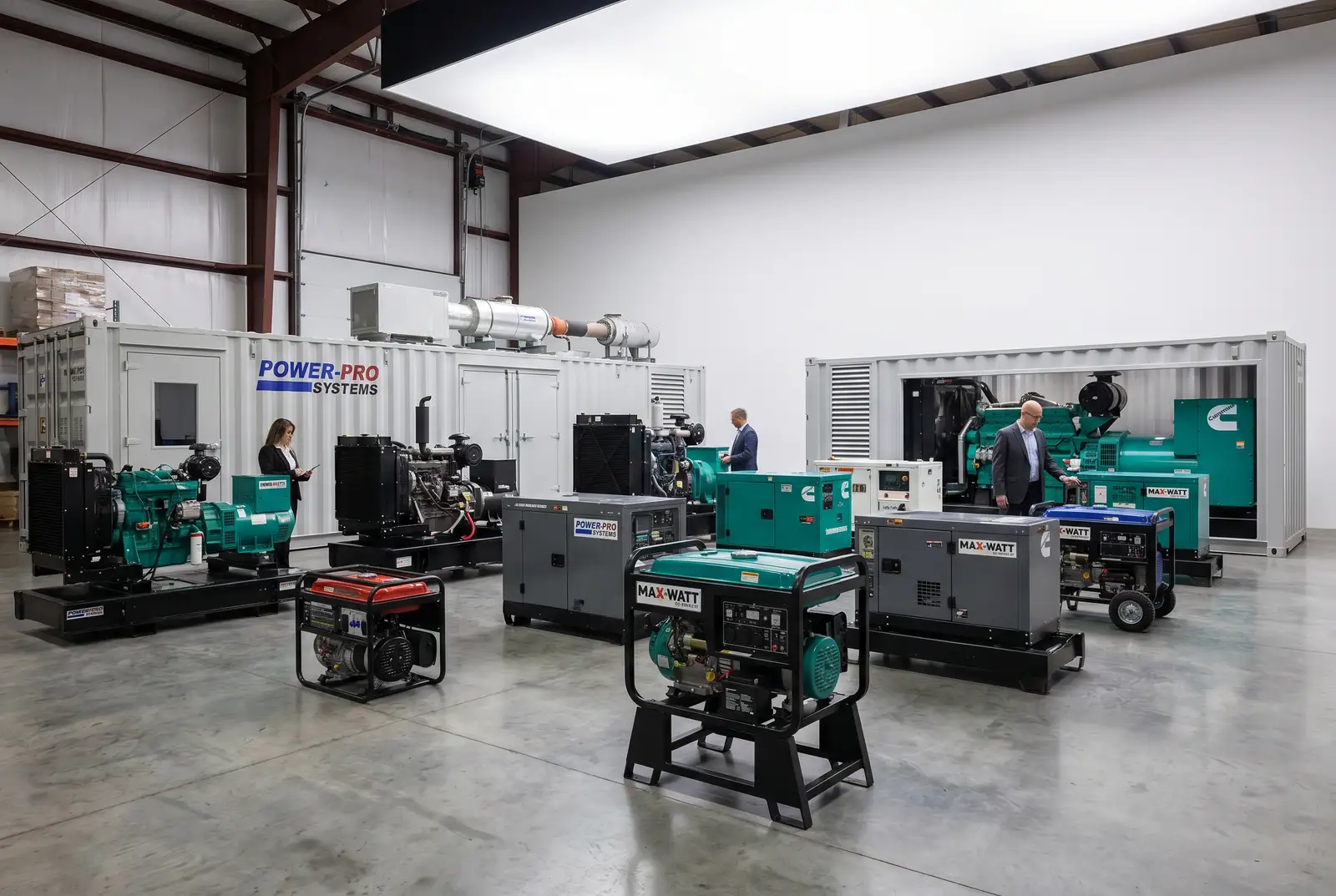
Generators serve as the foundational power generation equipment in the Energy & Power system. They convert mechanical energy from fuel combustion into electrical energy, providing primary or backup power for facilities ranging from small offices to large industrial sites.
Convert fuel energy to electricity for standalone or backup power supply
Construction sites, remote areas, emergency backup, outdoor events, industrial facilities
Power output capacity, fuel efficiency, noise level, emission standards, runtime duration
ATS (Auto Transfer Switch), Distribution Panel, Voltage Stabilizer, Fuel Storage System
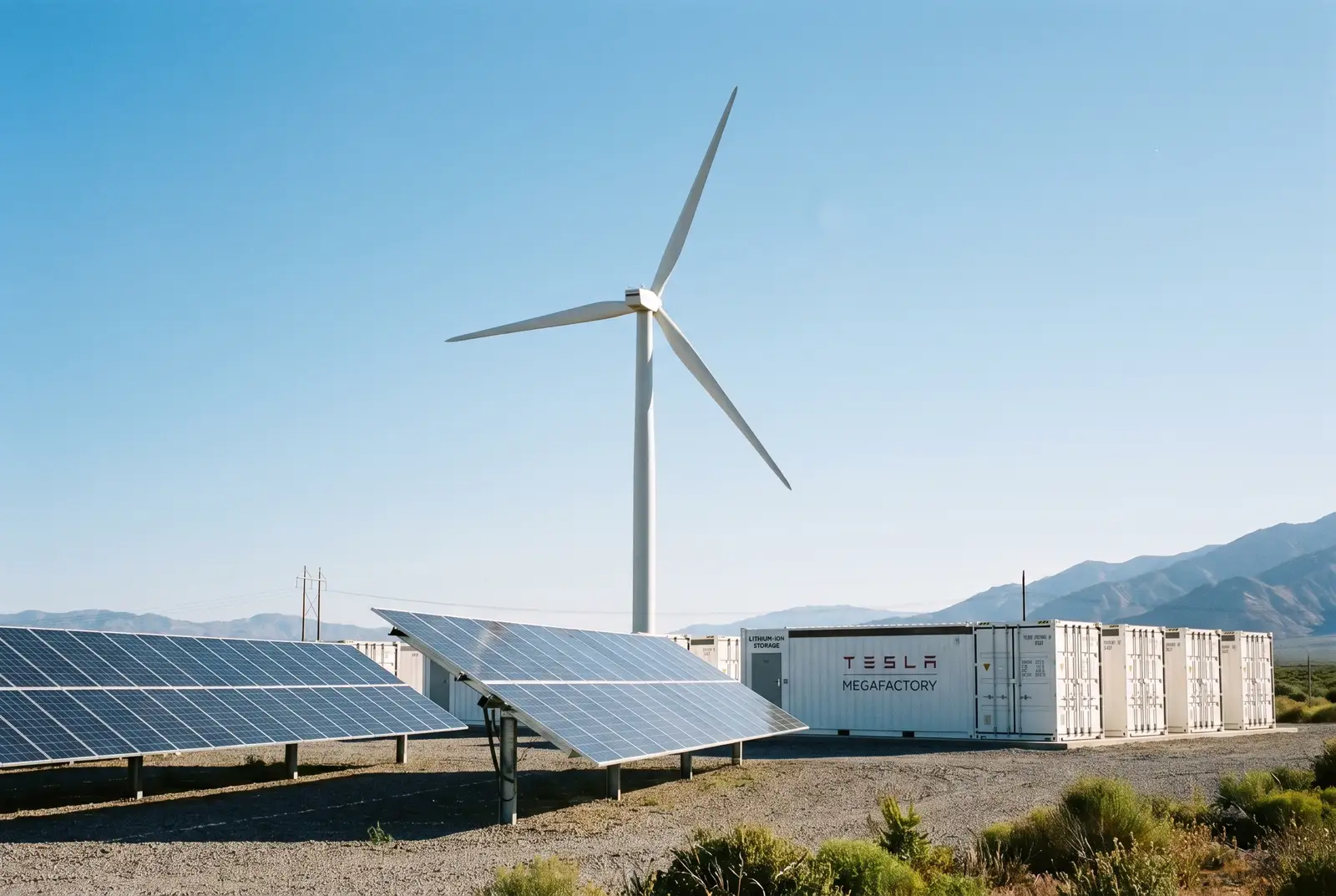
New Energy products represent the future of power generation, encompassing photovoltaic systems, wind turbines, hydropower equipment, and energy storage solutions. These technologies enable sustainable, renewable power generation that reduces carbon footprint and energy costs.
Generate clean electricity from renewable sources and store energy for later use
Commercial rooftops, solar farms, remote communities, grid-tied systems, off-grid installations
Solar irradiance, wind conditions, battery capacity, grid interconnection requirements, ROI period
Inverters, Battery Management Systems, Grid-tie Equipment, Monitoring Platforms
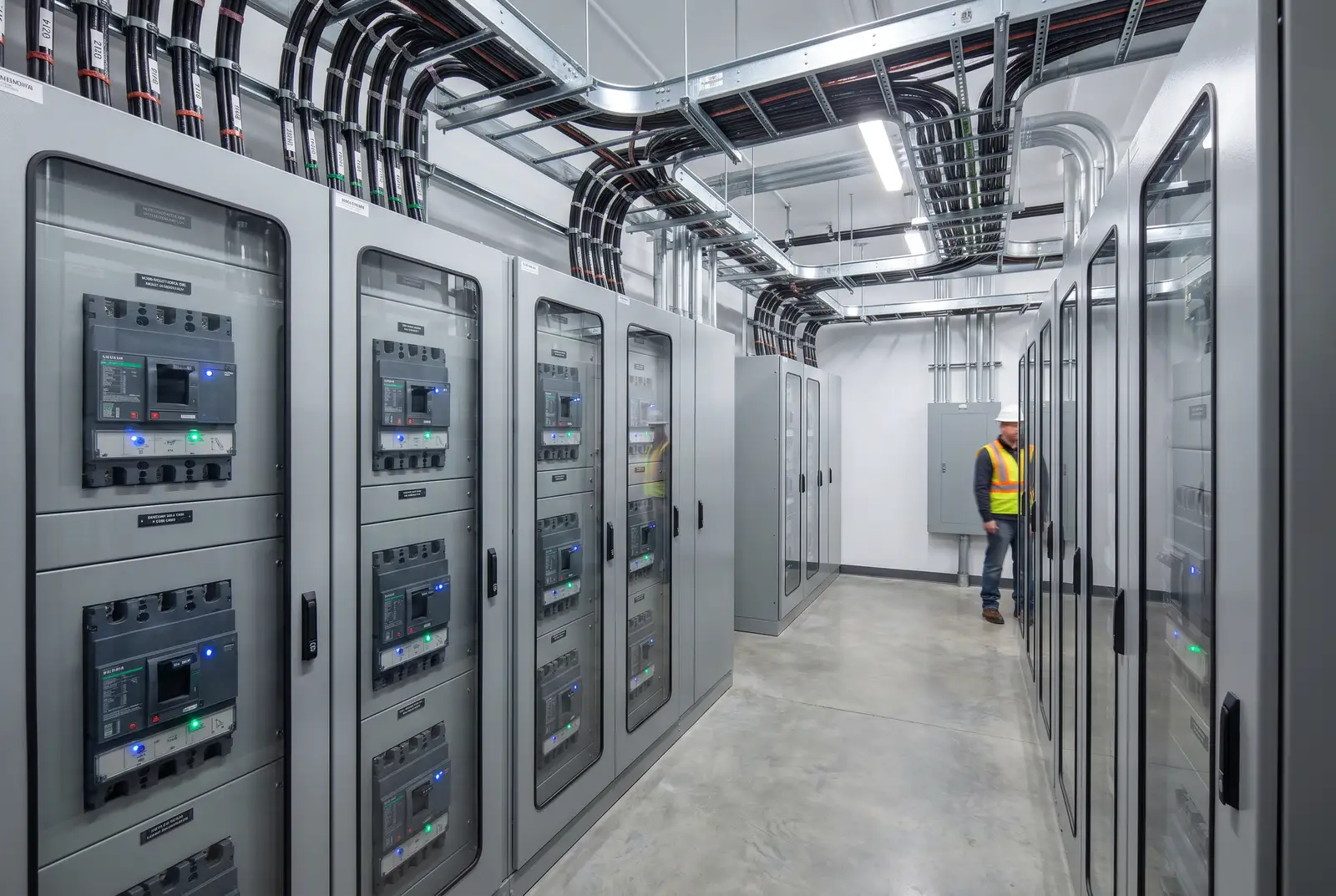
Distribution and control products form the backbone of power delivery, routing electricity from generation sources to end-use loads. They include circuit breakers, distribution panels, and prefabricated substations that ensure safe and efficient power distribution.
Route, control, and protect electrical power from source to load
Commercial buildings, industrial plants, residential complexes, data centers, infrastructure
Rated current, short-circuit capacity, number of circuits, enclosure rating, coordination
Transformers, Generators, SPD, Energy Meters, Busbars, Cable Systems
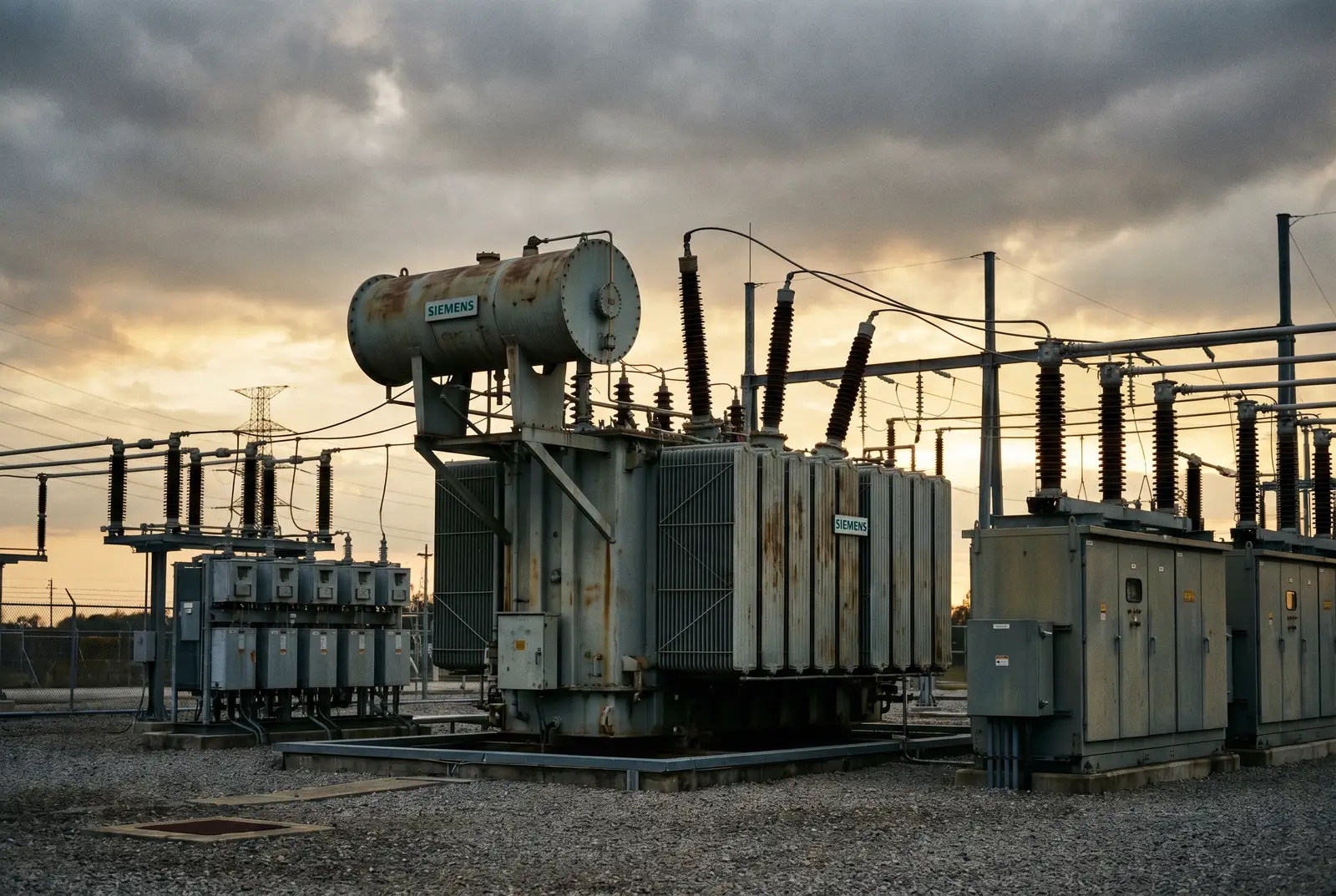
Voltage transformation and regulation equipment ensures that electrical power is delivered at the correct voltage level with stable, clean output. From high-voltage transformers to precision voltage stabilizers and VFDs, these products protect sensitive equipment and optimize power quality.
Transform voltage levels and maintain stable output for sensitive equipment
Industrial plants, hospitals, laboratories, CNC machines, telecommunications
Input/output voltage range, regulation accuracy, response time, load capacity, cooling method
Distribution Panels, SPD, Energy Monitoring, Circuit Breakers
Protection devices safeguard the entire power system against surges, overvoltage, undervoltage, short circuits, and other electrical faults. They are the safety net that prevents equipment damage, fire hazards, and system downtime.
Detect and isolate electrical faults to protect equipment and personnel
All power systems, lightning-prone areas, sensitive equipment installations, critical infrastructure
Response time, discharge capacity, protection levels, coordination with upstream devices
Circuit Breakers, Grounding Systems, Monitoring Equipment, Distribution Panels
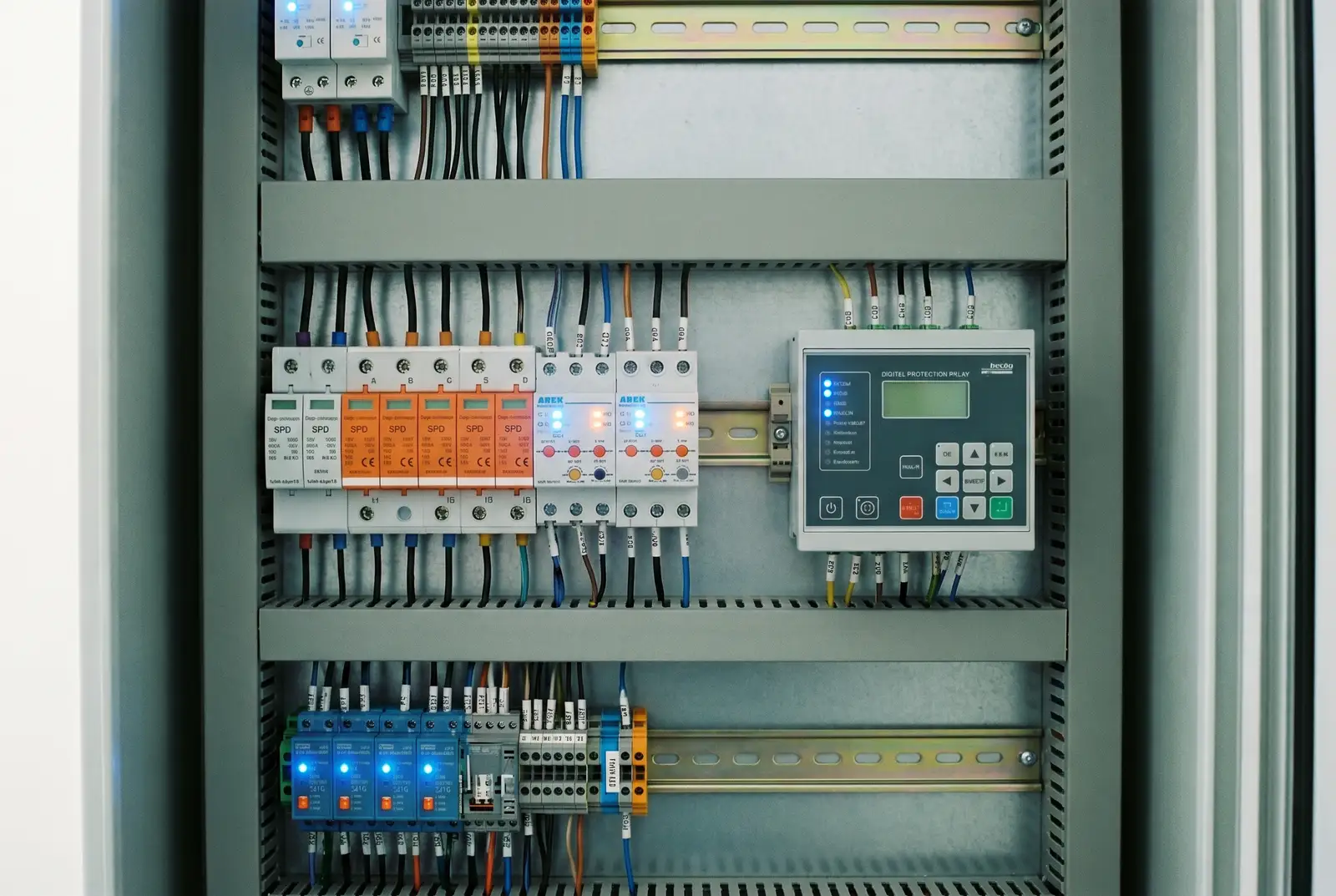
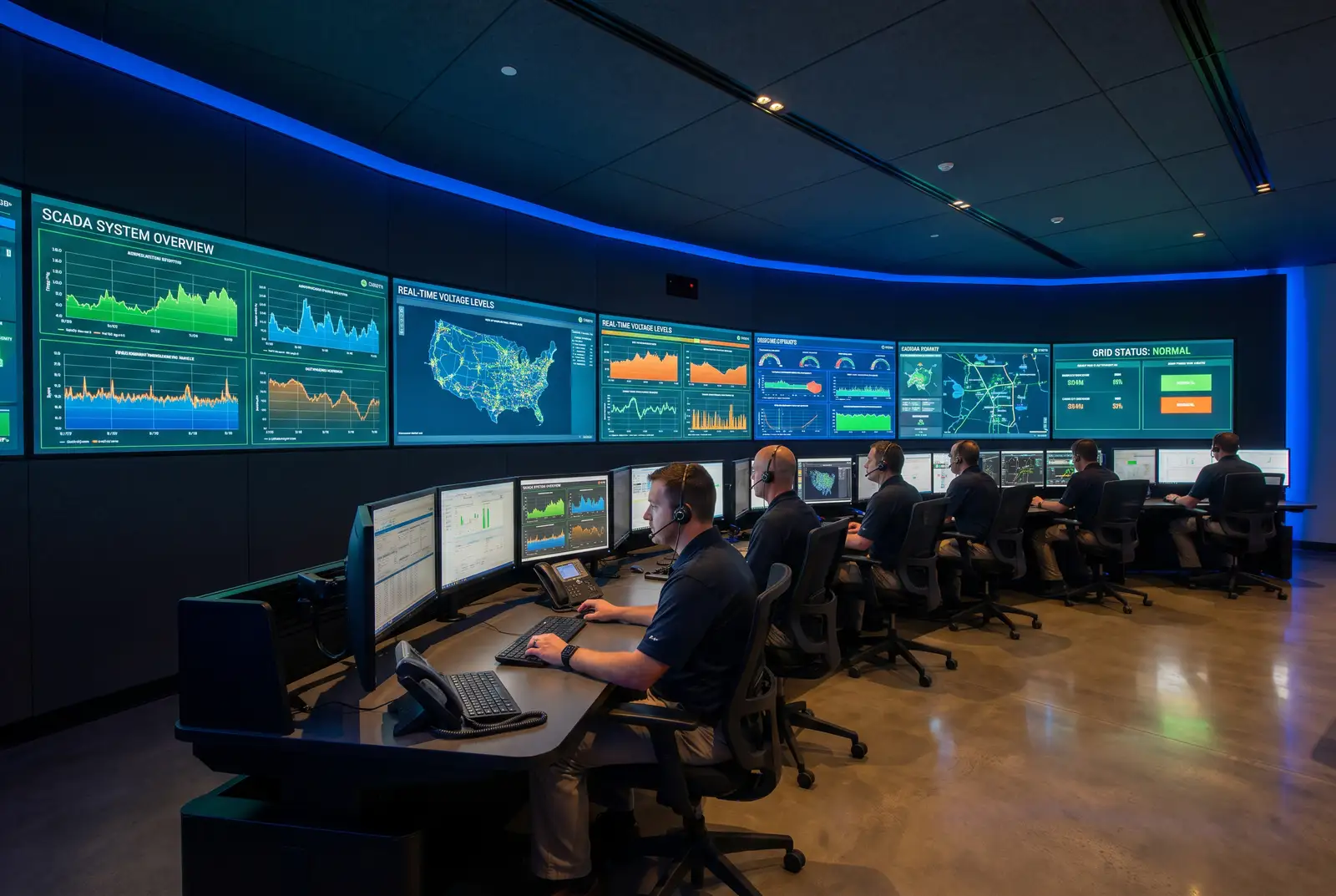
Management and monitoring products provide real-time visibility into power consumption, system performance, and energy efficiency. From smart meters to comprehensive EMS platforms, they enable data-driven decisions for energy optimization.
Monitor, measure, and optimize energy consumption and power quality
Commercial buildings, industrial facilities, utility networks, smart grid deployments
Measurement accuracy, communication protocols, data storage, integration capabilities
Voltage Transformers, Current Transformers, SCADA Systems, Cloud Platforms
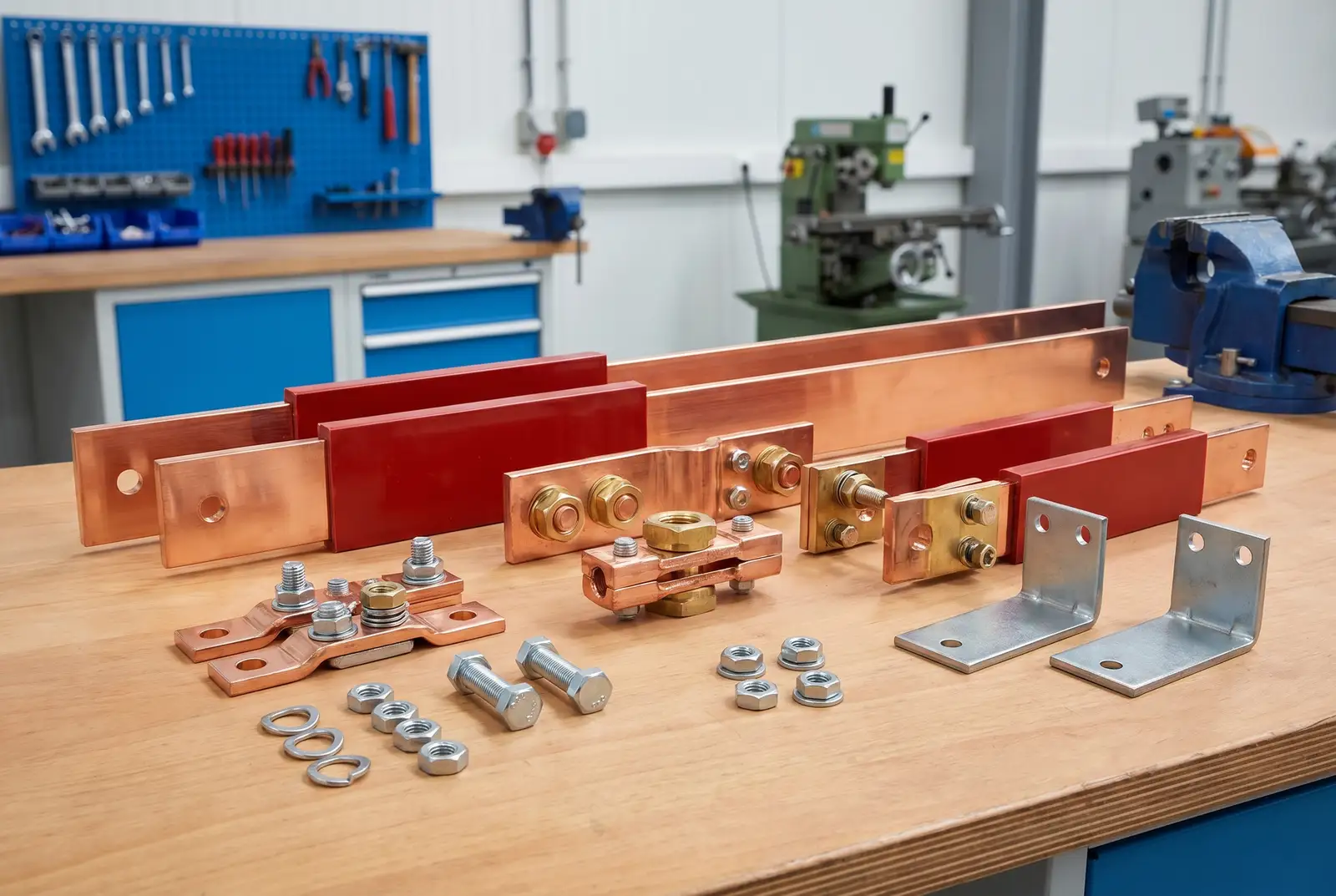
System components like busbars, cable trays, terminal blocks, and connectors form the physical infrastructure that connects all power system elements. While often overlooked, these components are critical for system reliability, safety, and maintainability.
Provide physical connections and structural support for power system elements
All electrical installations, panel building, switchgear assembly, cable management
Current rating, material quality, IP rating, thermal performance, ease of installation
Distribution Panels, Cable Systems, Enclosures, Mounting Hardware
Explore 12 professionally designed solutions. Click any card to view the full solution details.
 Generation
Ensure uninterrupted operations for small offices and retail spaces with a reliable gasoline generator backup system.
View Details →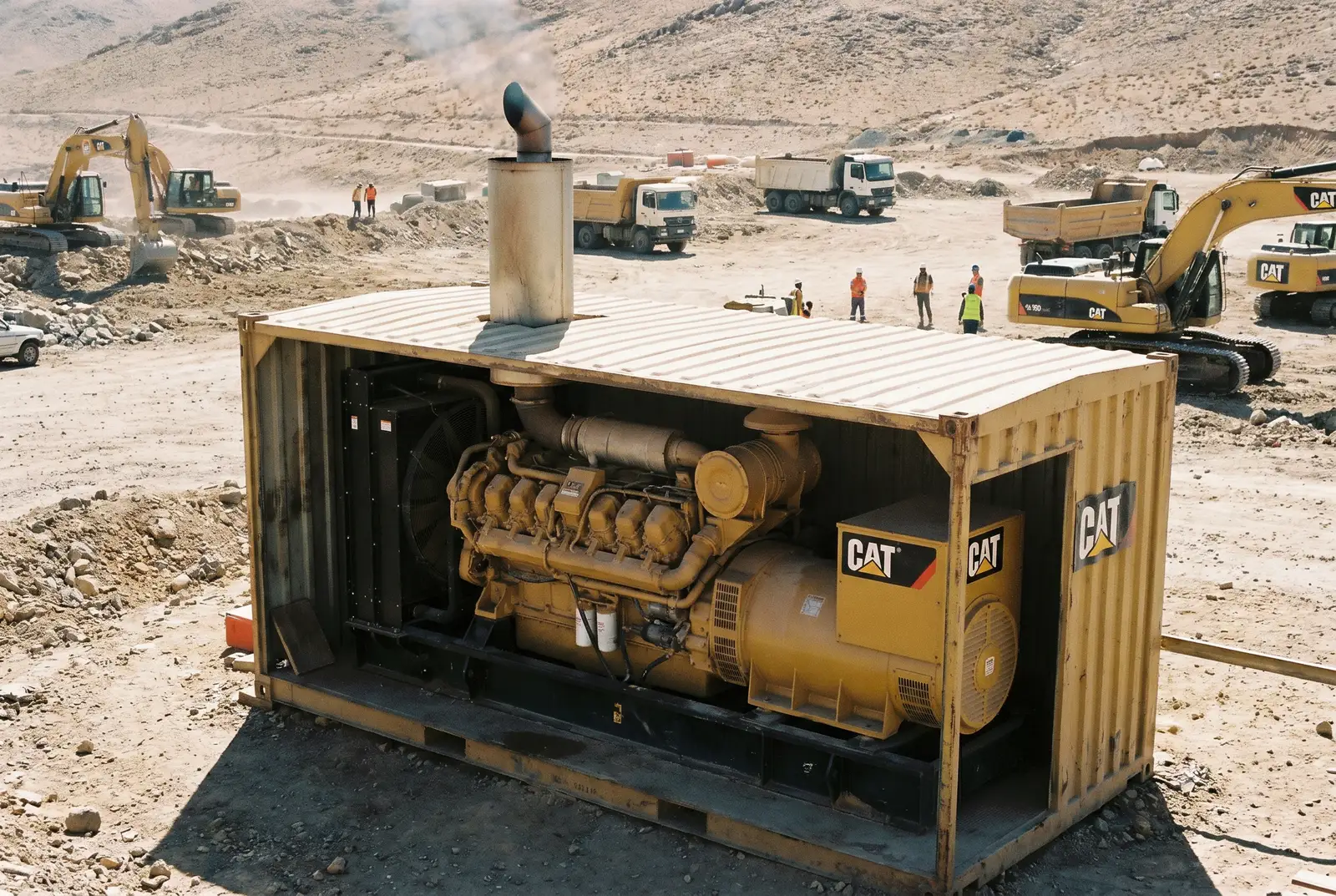 Generation
Power remote construction sites, mining operations, and off-grid facilities with robust diesel generator systems.
View Details →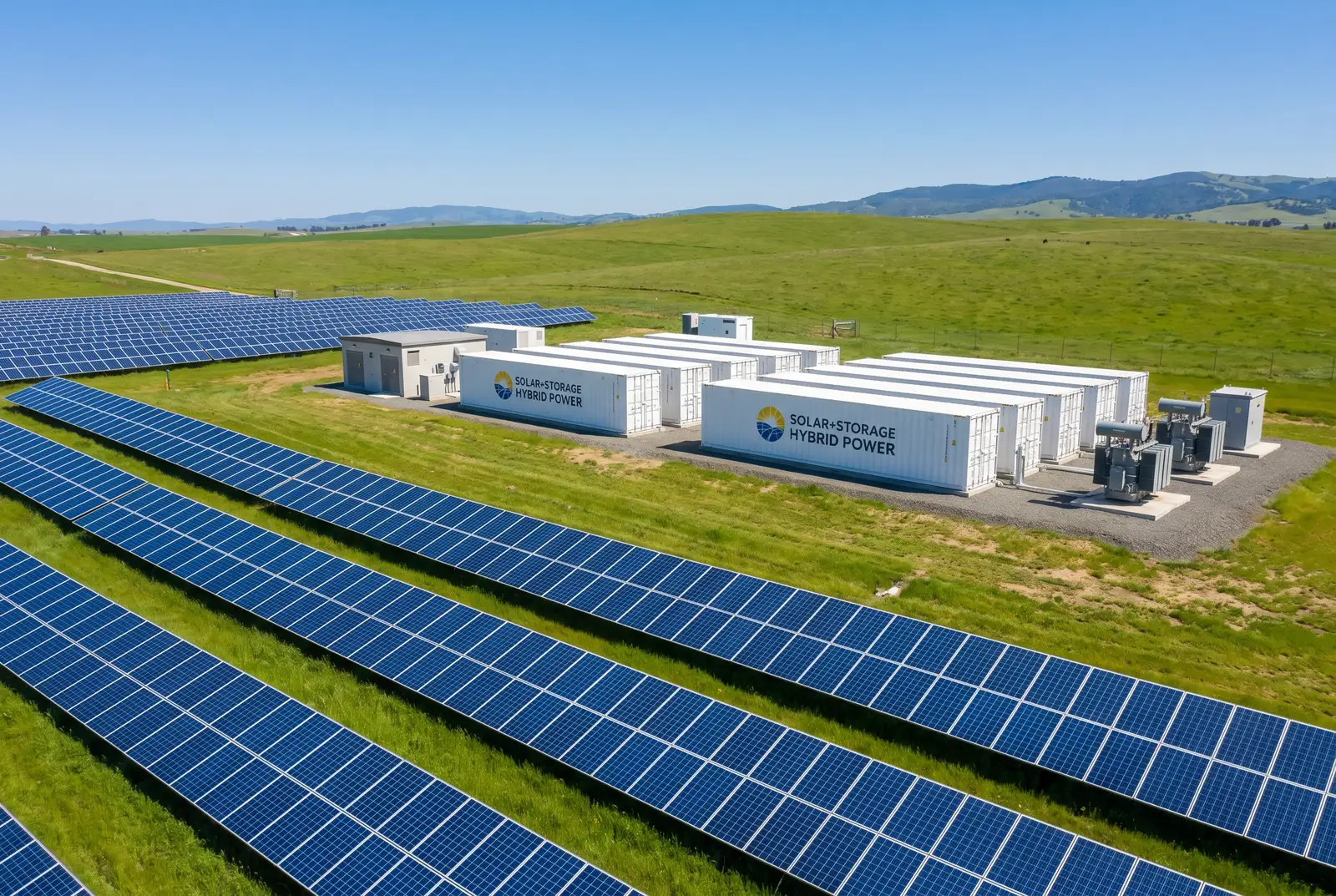 Generation
Combine photovoltaic generation with battery energy storage for a sustainable power system.
View Details →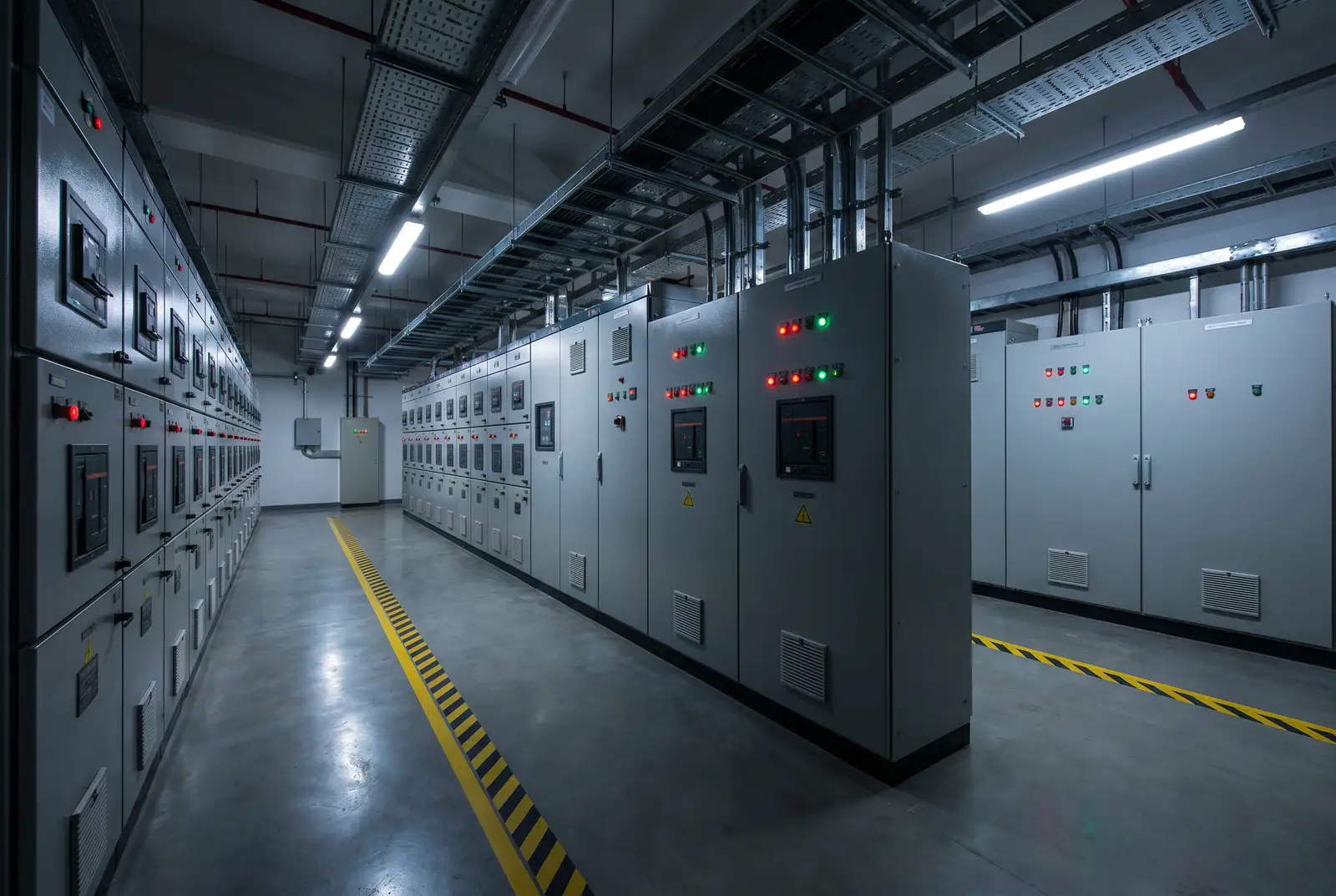 Distribution
Design and deploy comprehensive power distribution systems for manufacturing plants.
View Details →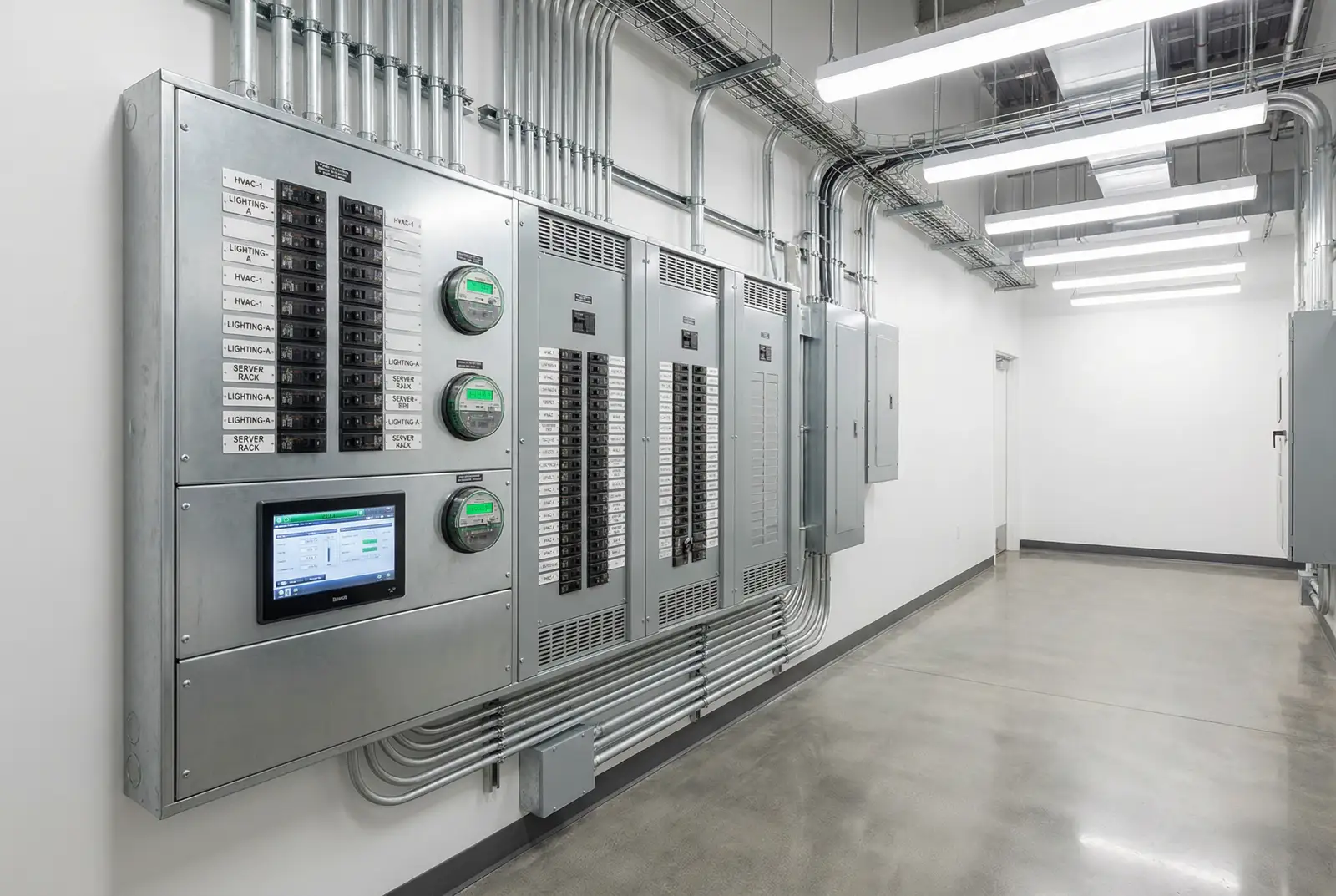 Distribution
Implement efficient power distribution for commercial buildings with centralized panel boards.
View Details →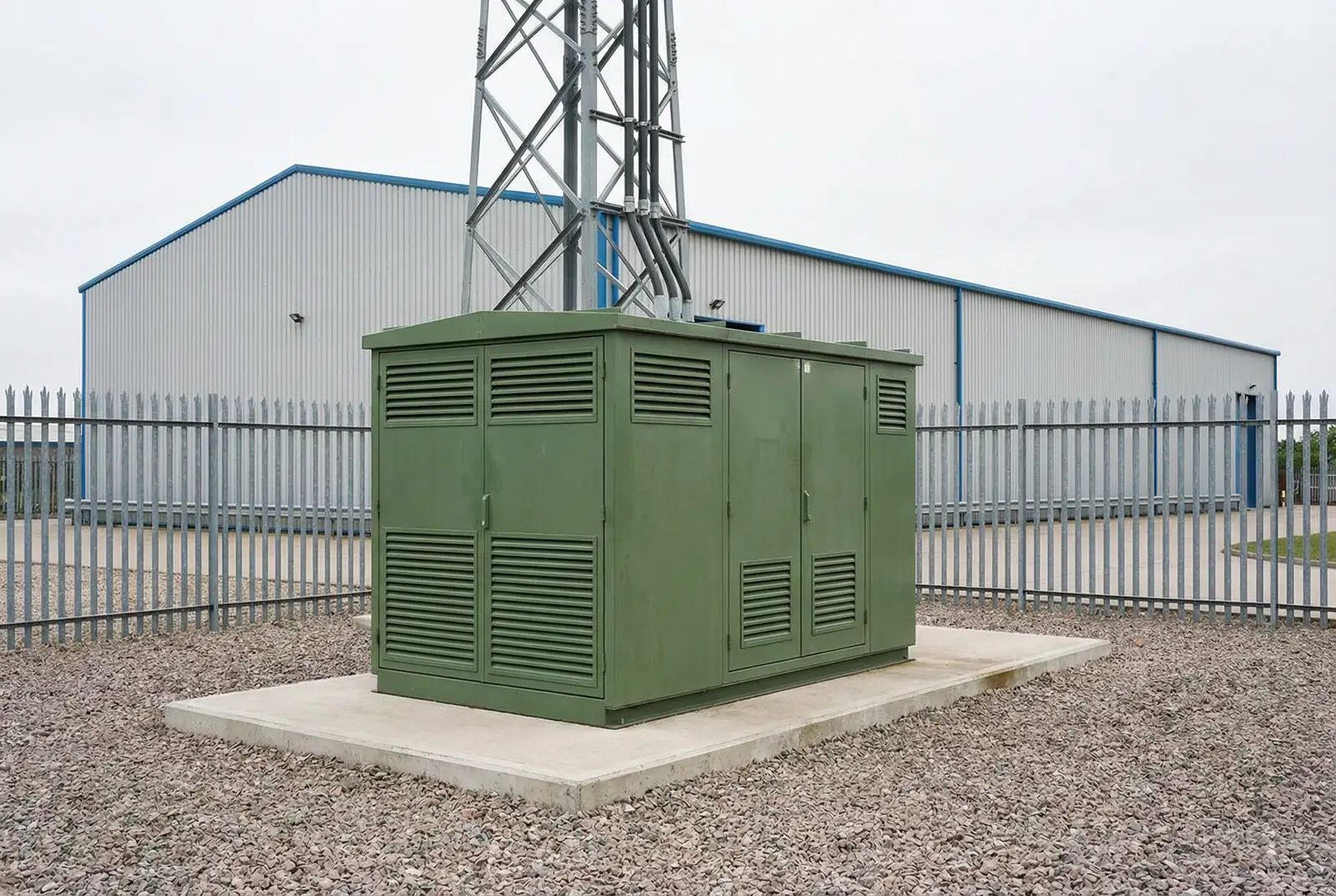 Distribution
Deploy compact, factory-assembled substations for rapid power infrastructure deployment.
View Details →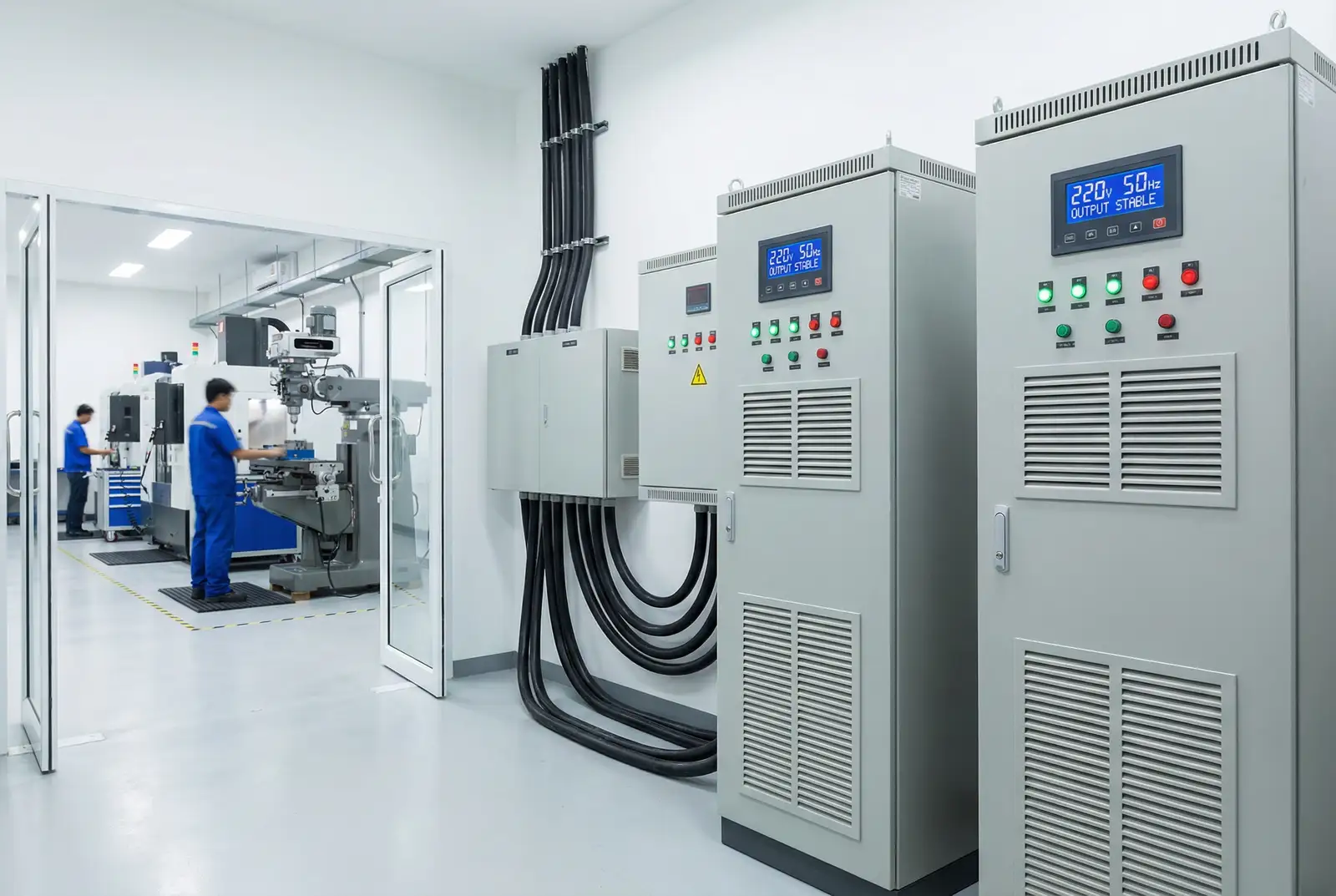 Regulation
Protect precision machinery, medical equipment, and IT infrastructure from voltage fluctuations.
View Details →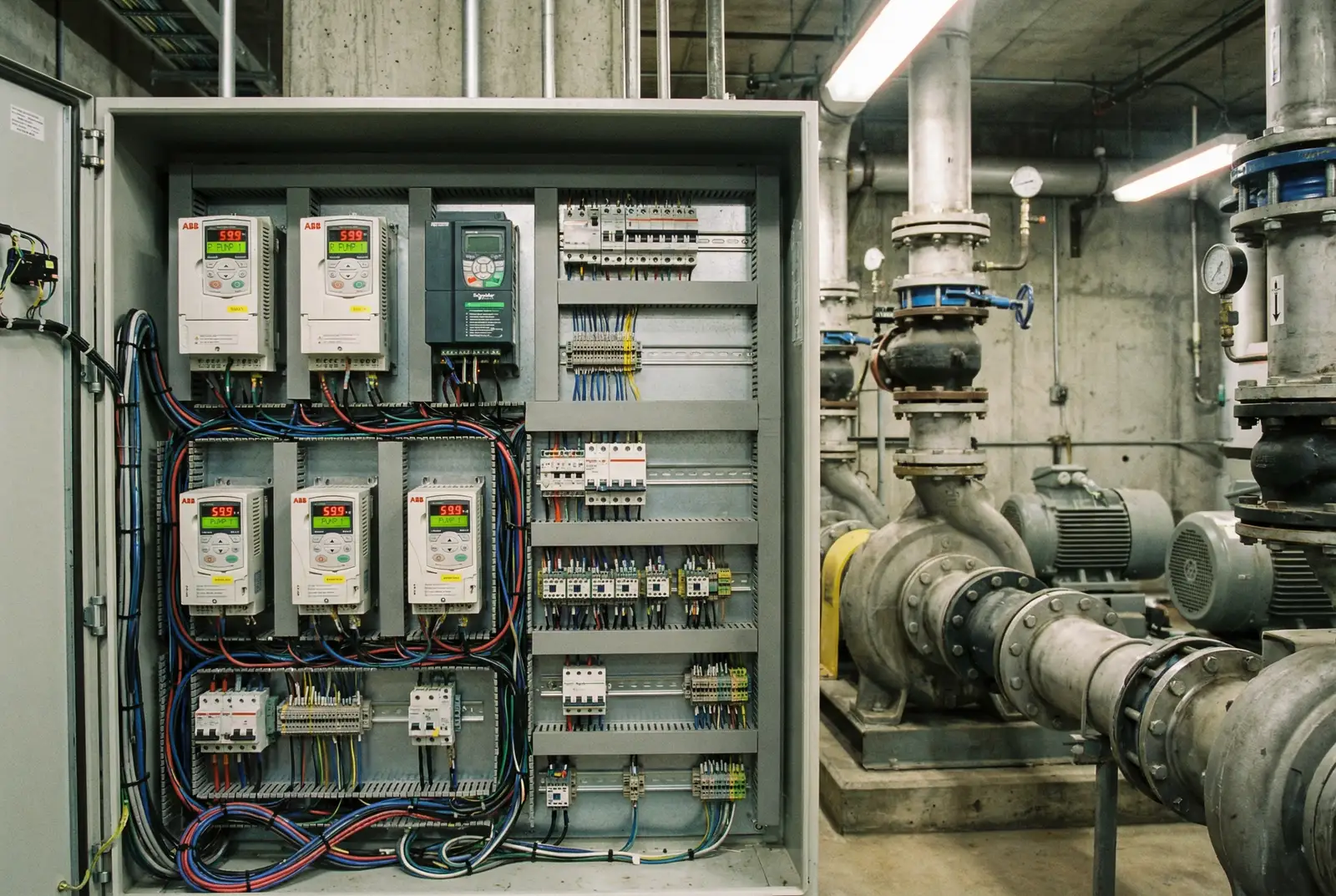 Regulation
Optimize motor-driven processes with variable frequency drives for energy savings.
View Details →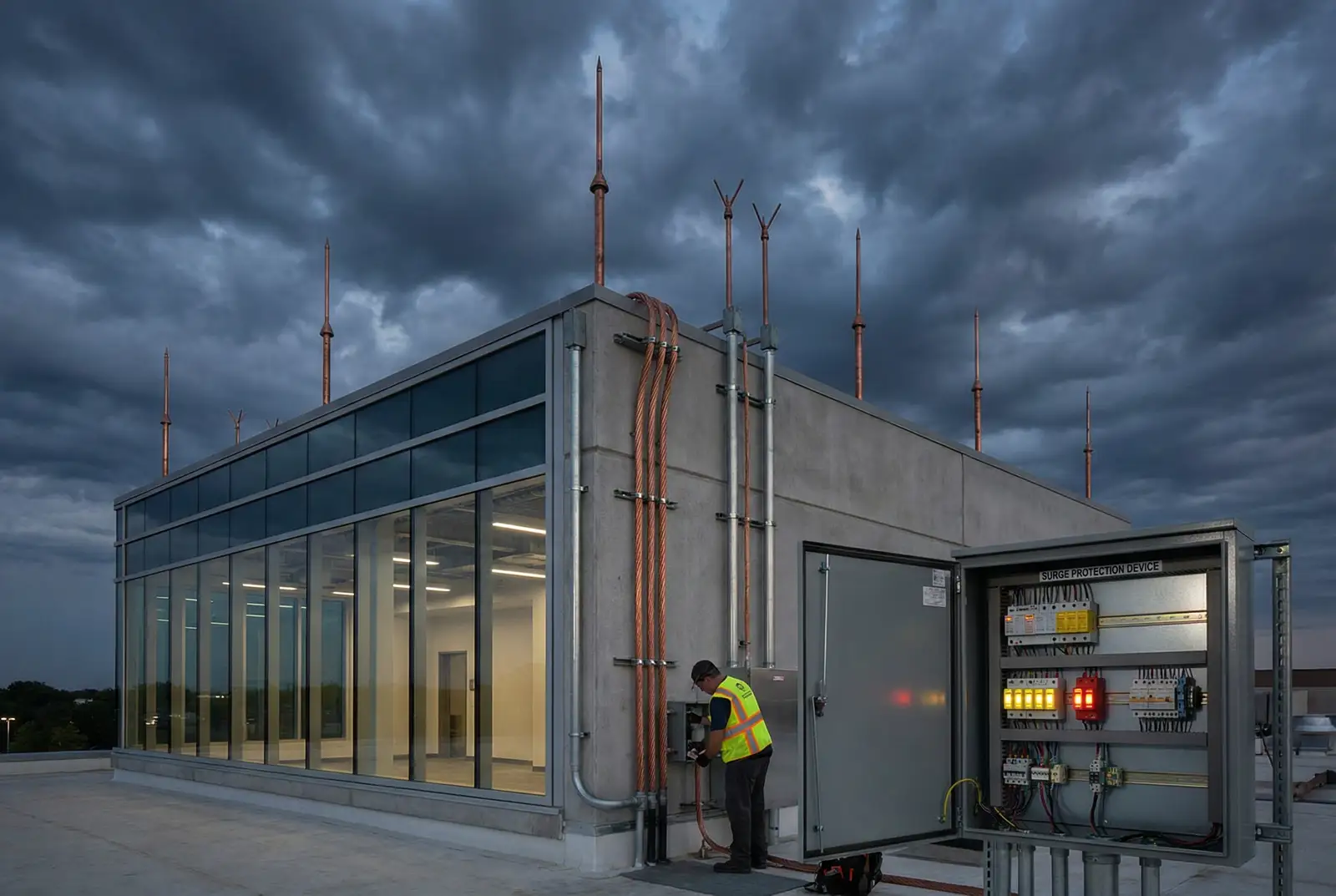 Protection
Implement multi-level surge protection to safeguard electrical systems from lightning strikes.
View Details →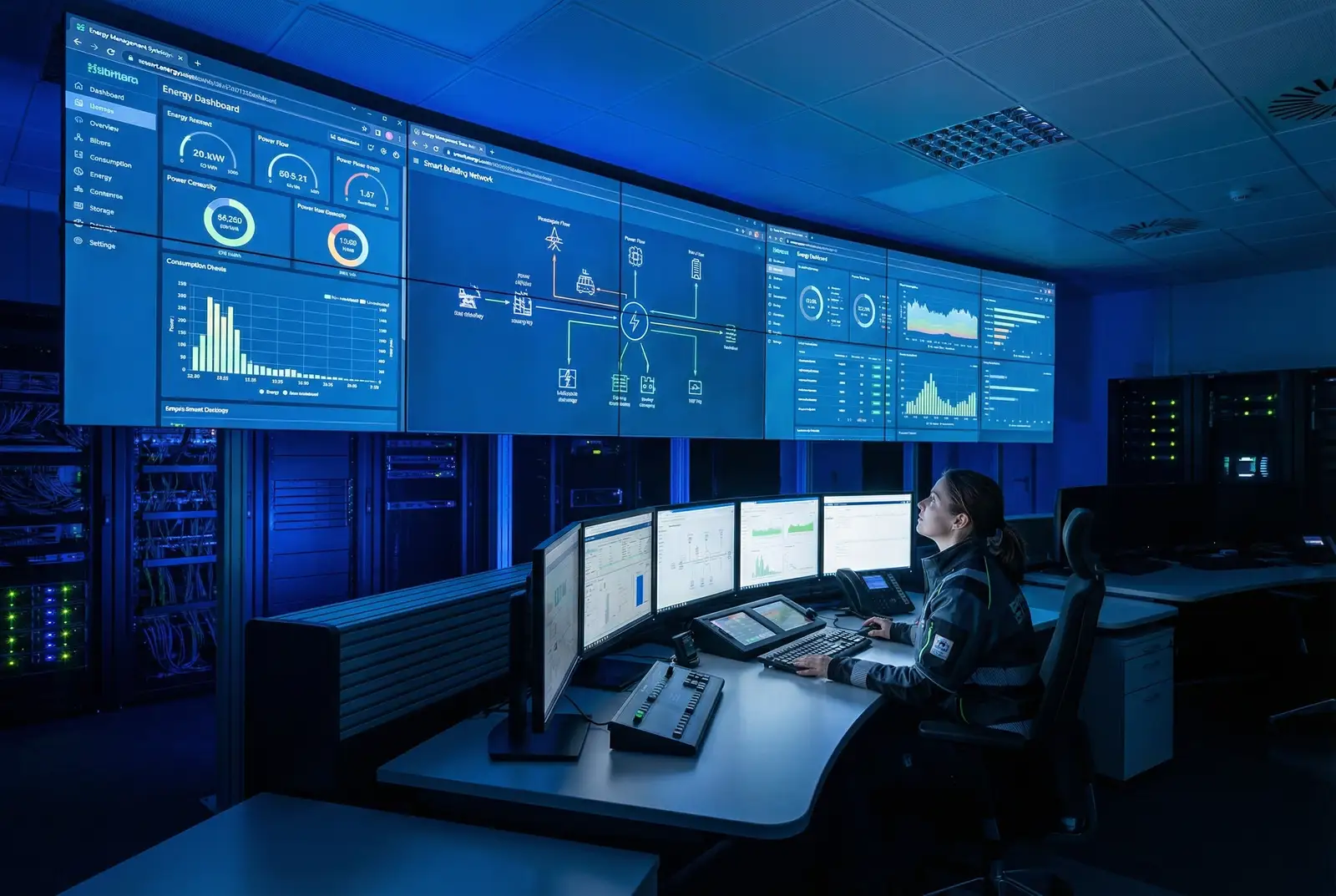 Monitoring
Deploy comprehensive energy management systems for real-time monitoring and optimization.
View Details →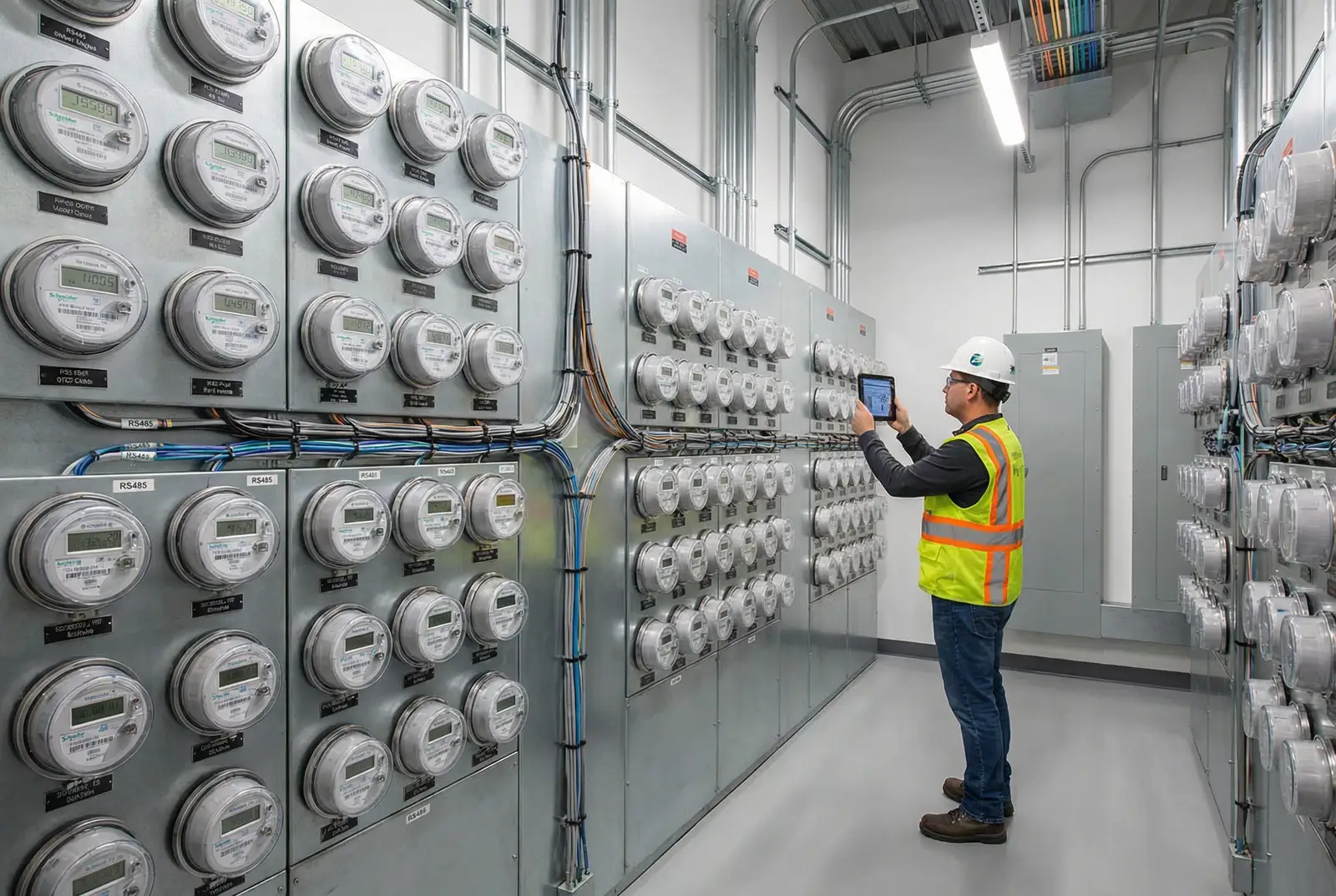 Monitoring
Implement smart metering infrastructure for accurate energy billing and demand management.
View Details →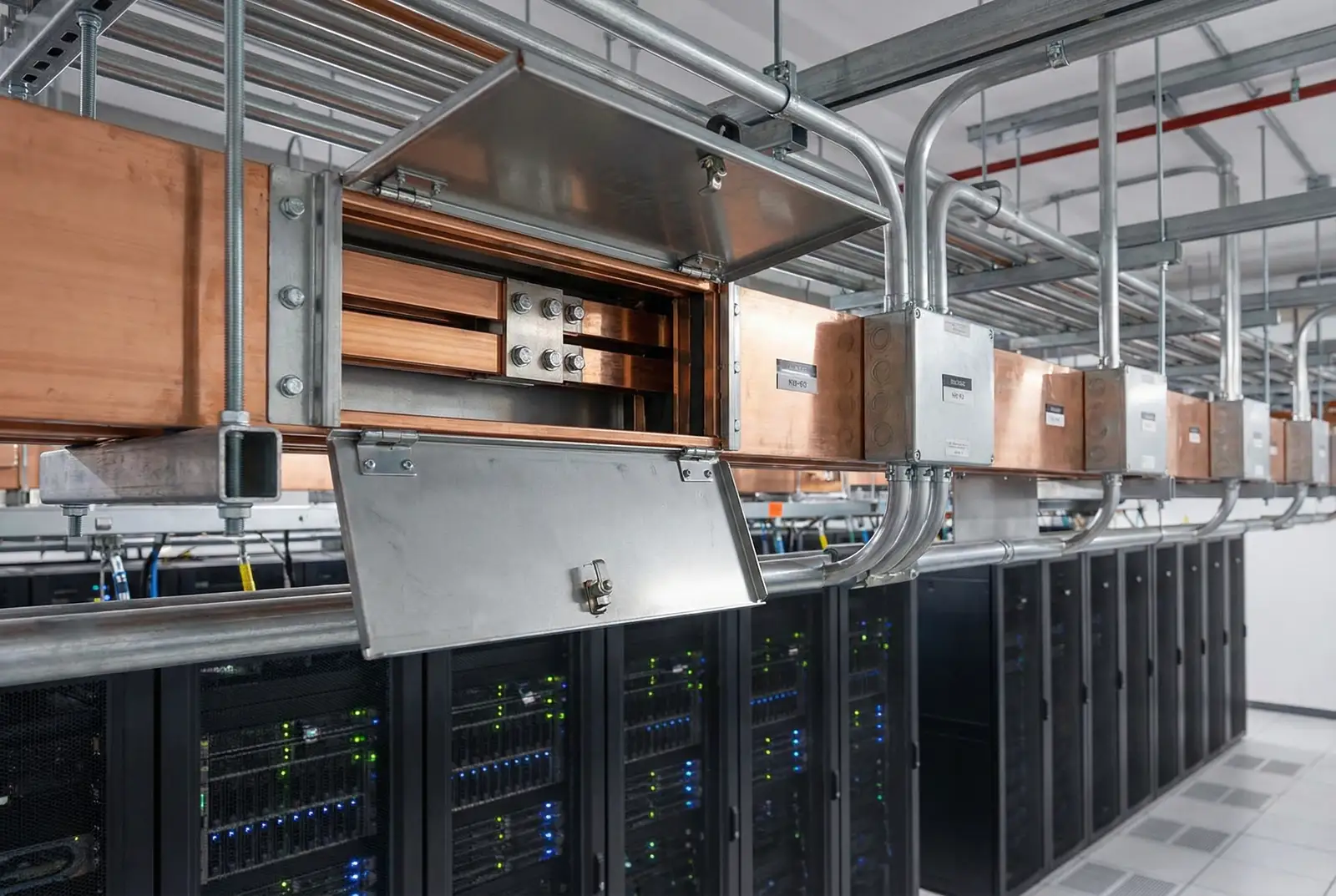 Components
Design and install high-capacity busbar systems for efficient power distribution.
View Details →
Selecting the right energy and power equipment is not about finding the cheapest option — it is about finding the right fit for your specific system, environment, and operational goals. This structured 5-step guide helps enterprise buyers move from vague requirements to confident, informed purchasing decisions.
Click any topic to explore detailed analysis and professional recommendations.
| Common Buying Mistake | VS | Professional Selection Logic |
|---|---|---|
| Choose the cheapest generator available | vs | Match generator capacity and fuel type to actual load profile and runtime needs |
| Buy circuit breakers based on price per unit | vs | Select breakers based on short-circuit rating, coordination, and protection curve |
| Skip surge protection to save budget | vs | Implement multi-level SPD based on lightning risk assessment and equipment sensitivity |
| Ignore voltage stabilizer and connect directly | vs | Measure actual voltage fluctuation range and select stabilizer with appropriate regulation accuracy |
| Install without energy monitoring | vs | Deploy smart metering and EMS from day one to enable data-driven optimization |
| Use residential-grade products in industrial settings | vs | Select industrial-grade products rated for the actual environmental and load conditions |
Beyond core power equipment, these supporting products ensure complete, reliable, and maintainable power system installations.
Cable lugs, terminal blocks, connectors, junction boxes, cable glands for reliable electrical connections.
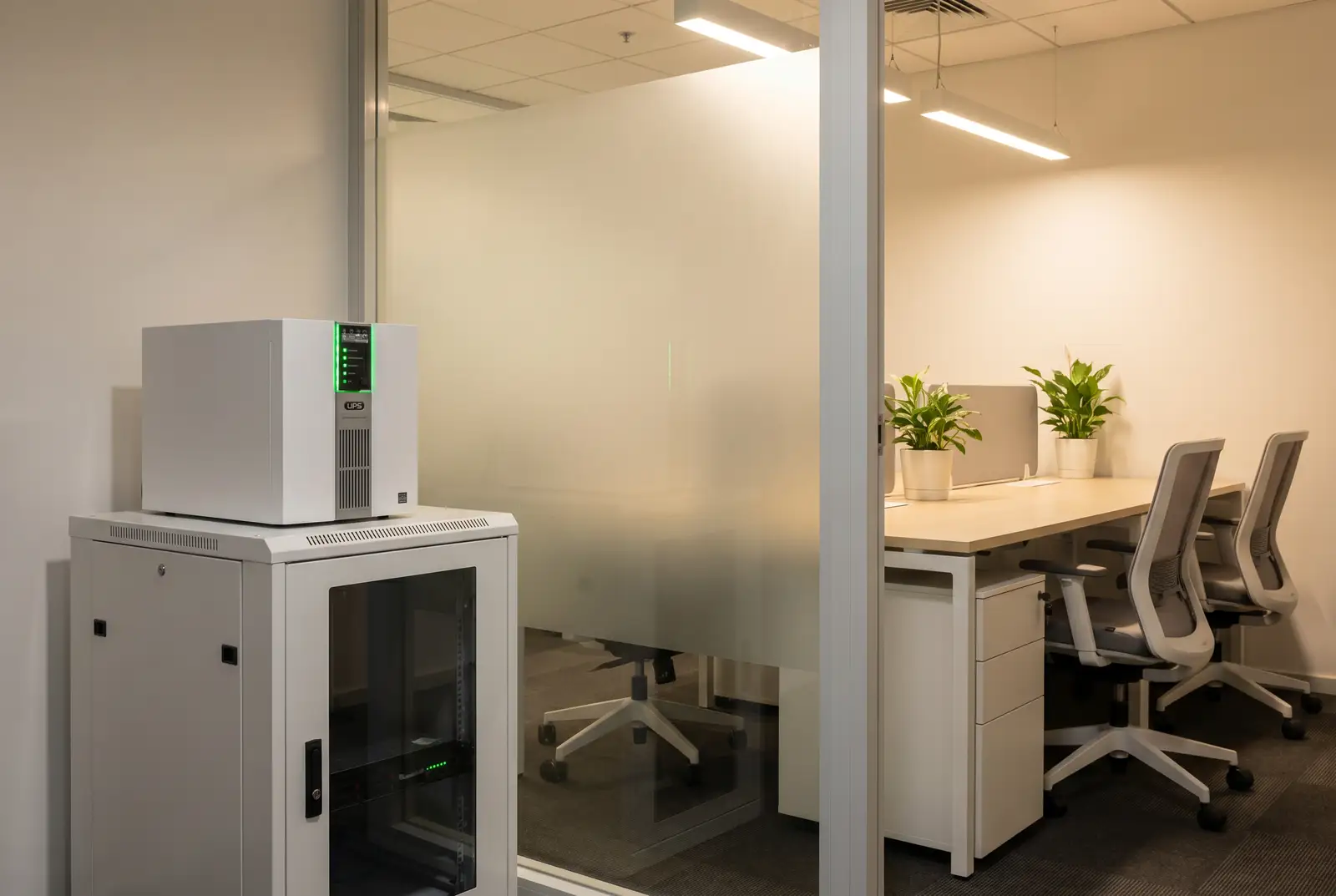
UPS systems, power strips, isolation transformers, line filters for clean and protected power delivery.
Current transformers, data loggers, communication gateways, SCADA interfaces for system visibility.
Electrical cabinets, outdoor enclosures, rack systems, ventilation fans for equipment housing and protection.
Dehumidifiers, air filters, temperature controllers, corrosion-resistant coatings for harsh environments.
Crimping tools, cable cutters, wire strippers, heat shrink tubing, electrical tape for installation work.
Multimeters, insulation testers, thermal cameras, power analyzers for commissioning and maintenance.
Replacement fuses, filters, belts, lubricants, and other consumables for ongoing maintenance.
Understanding and mitigating risks is essential for safe and compliant power system deployment.
Using non-certified or non-compliant electrical products poses significant legal and safety risks.
Before commissioning any power equipment, a systematic compliance check must be performed.
Regulatory requirements vary by jurisdiction and application.
Different operating scenarios present unique risk profiles.
Improper installation is one of the leading causes of electrical system failures.
Environmental factors significantly impact equipment performance and safety.
Many power system failures result from common but preventable misuse patterns.
Proactive risk management reduces incidents and protects investments.
Use these interactive tools to estimate capacity, configuration, and costs. Click any card to open the full calculator.
Calculate the required generator, transformer, or UPS capacity based on your total load and power factor.
Determine the optimal number of power units based on total load, unit capacity, and redundancy mode (N, N+1, 2N).
Estimate daily, monthly, and annual energy consumption, operating costs, and generator capacity requirements.
Select your facility type and area to get recommended power products and system configuration tailored to your use case.
When you haven't finalized the exact specifications, quantities, installation environment, or application boundaries, start with our Demand Survey. Our team will analyze your requirements and provide tailored product recommendations.
Ensure uninterrupted operations for small offices and retail spaces with a reliable gasoline generator backup system, including ATS, distribution panel, and voltage stabilizer.
This solution provides a complete, turnkey backup power system designed specifically for small offices (50-200 sqm) and retail spaces that cannot afford power interruptions. The system centers around a compact gasoline generator paired with an Automatic Transfer Switch (ATS) that seamlessly switches power sources during grid outages, ensuring zero manual intervention is needed.
The solution addresses the full power chain from generation to end-use protection: the generator provides emergency power, the ATS handles automatic switchover, a distribution panel manages circuit-level protection, and a voltage stabilizer ensures clean power delivery to sensitive office equipment such as computers, printers, and network devices.
Typical deployment takes 1-2 days and requires minimal infrastructure preparation. The system is designed for offices where downtime costs exceed $500/hour and grid reliability is below 99.5%.
The system follows a dual-source architecture: Grid Power and Generator both feed into the ATS, which selects the active source. The ATS output passes through a Voltage Stabilizer for power conditioning, then enters a 12-way Distribution Panel that serves individual circuits for office equipment, lighting, HVAC, and network infrastructure.
System Connection Diagram
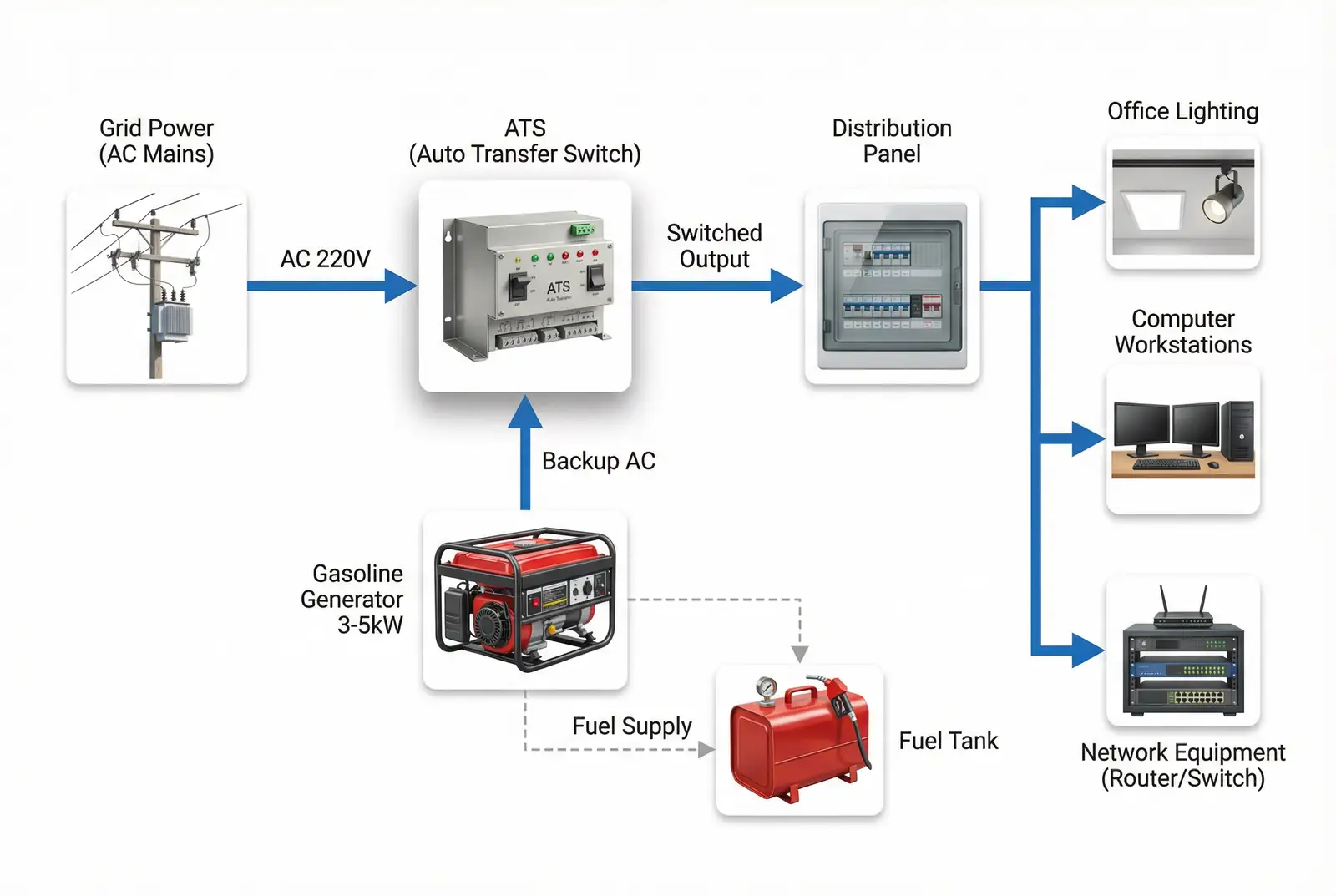
The following products form the core of this solution. Each is selected for optimal performance, reliability, and system compatibility.
5kW, Single Phase, Electric Start
Primary backup power source providing 5kW output capacity, sufficient for typical small office loads including computers, lighting, and small HVAC units.
Key Parameters: Output: 5kW / 6.25kVA | Voltage: 220V/50Hz | Fuel: Gasoline | Runtime: 8-12hrs at 75% load | Noise: <72dB | Start: Electric + Recoil
63A, Dual Power, Auto Changeover
Monitors grid power and automatically switches to generator within 10 seconds of outage detection. Returns to grid when stable power is restored.
Key Parameters: Rating: 63A | Poles: 4P | Transfer Time: <10s | Voltage Range: 160-260V | Type: PC Class
12-way, MCB Protected
Central distribution point with individual circuit breakers for each office zone, providing overload and short-circuit protection.
Key Parameters: Ways: 12 | Main Switch: 63A | MCBs: 10A-32A | IP Rating: IP30 | Mounting: Surface/Flush
5kVA, Servo Motor Type
Conditions generator output to stable 220V±2%, protecting sensitive electronics from voltage fluctuations during generator operation.
Key Parameters: Capacity: 5kVA | Input: 160-260V | Output: 220V±2% | Response: <0.5s | Type: Servo Motor
Type 2, 40kA
Protects downstream equipment from transient surges during power source switching and lightning events.
Key Parameters: Type: Type 2 (Class II) | Imax: 40kA | Uc: 275V | Response: <25ns
Use the following table to select the appropriate configuration based on your specific requirements:
| Office Size | Generator | ATS | Stabilizer | Panel |
|---|---|---|---|---|
| Small (50-100 sqm) | 3kW Gasoline | 32A ATS | 3kVA | 8-way |
| Medium (100-200 sqm) | 5kW Gasoline | 63A ATS | 5kVA | 12-way |
| Large (200-400 sqm) | 8-10kW Gasoline | 100A ATS | 10kVA | 18-way |
Small offices, retail shops, clinics, branch banks, convenience stores, small restaurants, home offices, and any commercial space under 400 sqm where power continuity is critical for daily operations.
Zero downtime during grid outages lasting up to 8-12 hours. The ATS ensures automatic switchover within 10 seconds, and the voltage stabilizer protects all connected equipment from power quality issues. Typical ROI is achieved within 6-12 months for businesses where hourly downtime cost exceeds $200. Estimated total investment: $2,000-5,000 depending on capacity and brand selection.
Power remote construction sites, mining operations, and off-grid facilities with robust diesel generator systems designed for continuous heavy-duty operation.
This solution delivers reliable primary power to remote locations without grid access, using industrial-grade diesel generators rated for continuous duty operation. Designed for the harshest environments — from desert construction sites to mountain mining operations — the system includes comprehensive fuel management, weatherproof distribution, environmental protection, and remote monitoring capabilities.
The diesel generator serves as the primary (and often sole) power source, making reliability and fuel efficiency paramount. The solution incorporates automatic fuel transfer from bulk storage to day tanks, ensuring uninterrupted operation. All distribution equipment is rated for outdoor use with appropriate IP protection, and remote monitoring via GSM or satellite enables centralized management of multiple remote sites.
This solution is engineered for 24/7 operation with scheduled maintenance intervals of 250-500 hours, and includes provisions for parallel operation when load growth requires additional capacity.
The system uses a fuel chain architecture: Main Fuel Storage (5000L) feeds via Auto Transfer Pump to a Day Tank (500L), which supplies the Diesel Generator (100-200kW). Generator output connects to an Outdoor-rated Main Distribution Board with full SPD and earth leakage protection, distributing power to construction equipment, site offices, and lighting. A parallel Remote Monitoring System with GSM/satellite communication provides real-time status and alerts.
System Connection Diagram
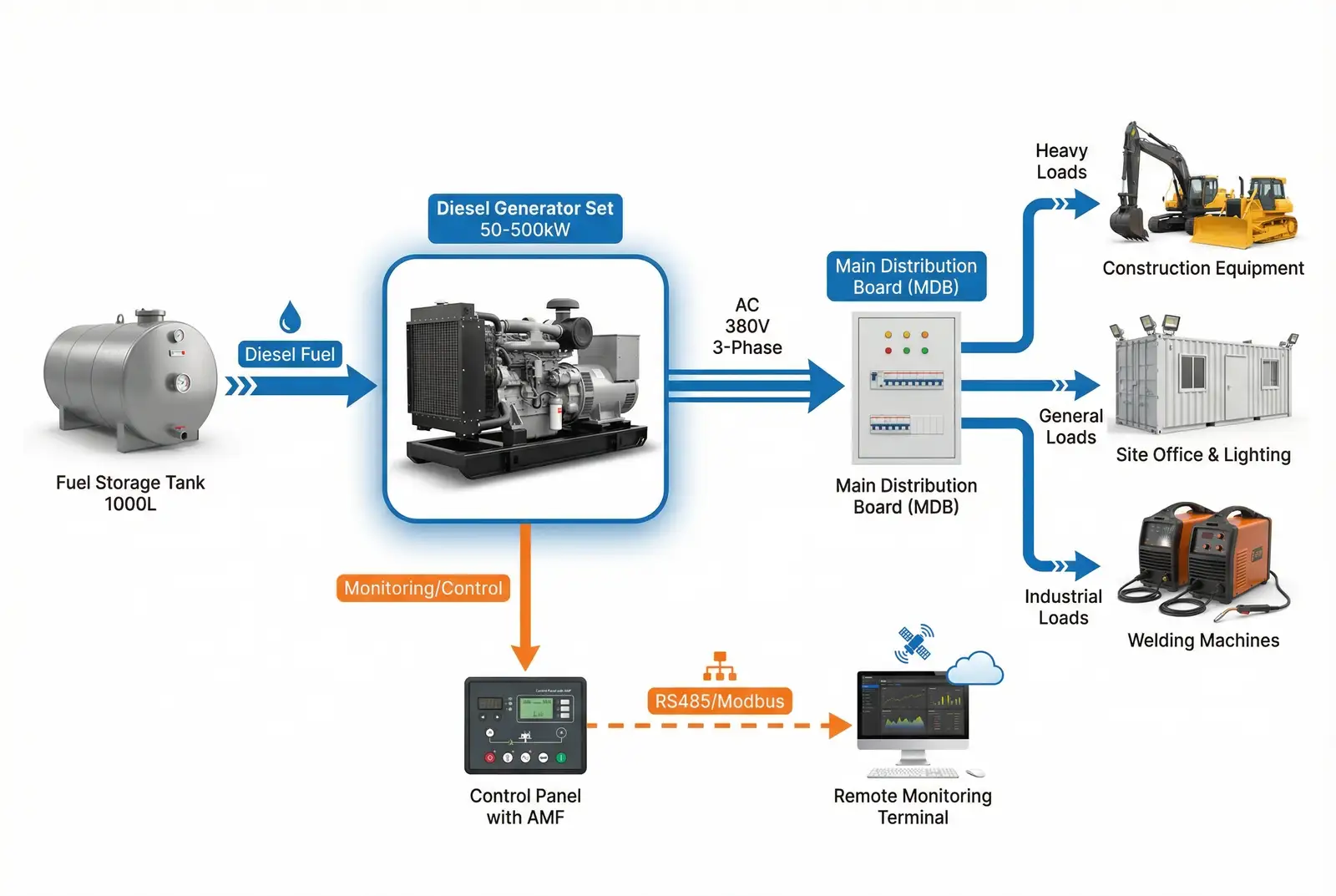
The following products form the core of this solution. Each is selected for optimal performance, reliability, and system compatibility.
100-200kW, Soundproof Canopy
Primary power source for continuous duty operation. Soundproof canopy reduces noise for site accommodation areas. Designed for 24/7 operation with 250-hour service intervals.
Key Parameters: Output: 100-200kW | Voltage: 380V/220V 50Hz | Fuel: Diesel | Runtime: Continuous | Noise: <75dB at 7m | Cooling: Radiator
5000L Main Tank + 500L Day Tank
Bulk fuel storage with automatic transfer to day tank ensures uninterrupted operation. Includes fuel level monitoring, leak detection, and bund containment.
Key Parameters: Main Tank: 5000L | Day Tank: 500L | Transfer: Automatic pump | Monitoring: Level sensor + alarm | Containment: 110% bund
IP65, 400A Main Switch
Weatherproof main distribution board rated for outdoor installation in harsh environments. Provides circuit-level protection for all site loads.
Key Parameters: Rating: 400A | IP: IP65 | Material: Stainless Steel | MCCBs: Adjustable | Earth Leakage: 30mA/300mA
Type 1+2, Full Earth System
Combined surge protection and comprehensive earthing system for remote sites with high lightning exposure.
Key Parameters: SPD: Type 1+2 Combined | Imax: 100kA | Earth: Rod + mesh system | ELCB: 30mA for personnel, 300mA for equipment
GSM/Satellite, Cloud Dashboard
Enables centralized monitoring and management of remote generators. Provides real-time alerts for fuel level, faults, and maintenance schedules.
Key Parameters: Communication: GSM/4G + Satellite backup | Data: Real-time + historical | Alerts: SMS/Email | Interface: Web dashboard + mobile app
Use the following table to select the appropriate configuration based on your specific requirements:
| Site Type | Generator | Fuel Storage | Distribution | Monitoring |
|---|---|---|---|---|
| Small Site (10-20 workers) | 50-80kW Diesel | 2000L + 200L | 200A IP65 Board | GSM Basic |
| Medium Site (20-100 workers) | 100-200kW Diesel | 5000L + 500L | 400A IP65 Board | GSM + Cloud |
| Large Site (100+ workers) | 2x200kW Parallel | 10000L + 1000L | 800A + Sub-boards | Satellite + SCADA |
Remote construction sites, mining operations, oil and gas exploration camps, military field installations, disaster relief operations, agricultural processing facilities, and any off-grid location requiring reliable continuous power from 50kW to 500kW+.
Reliable 24/7 power supply with 99.5%+ availability when properly maintained. Fuel efficiency optimization through load management can reduce fuel costs by 15-25%. Remote monitoring reduces site visits by 60% and enables predictive maintenance. Typical system lifespan: 15,000-30,000 operating hours. Estimated investment: $30,000-150,000 depending on capacity and site requirements.
Combine photovoltaic generation with battery energy storage for a sustainable, cost-effective power system that reduces grid dependency and carbon footprint.
This hybrid solution integrates solar photovoltaic panels with battery energy storage systems (BESS) to create a sustainable, resilient power system. The solution is designed for commercial buildings, industrial facilities, and remote installations seeking to reduce grid dependency, lower energy costs, and minimize carbon footprint.
The system uses high-efficiency monocrystalline solar panels paired with lithium-ion battery storage and a hybrid inverter capable of both grid-tied and off-grid operation. An intelligent Energy Management System (EMS) optimizes power flow between solar generation, battery storage, grid supply, and building loads based on real-time demand, tariff rates, and weather forecasts.
The solution supports multiple operating modes: self-consumption maximization, peak shaving, time-of-use arbitrage, and full off-grid backup. System sizing is customized based on load profile, available roof/ground area, solar irradiance data, and financial objectives.
Solar PV Array connects to MPPT Controller for maximum power extraction, feeding DC power to the Battery Storage System (Lithium-ion with BMS). The Hybrid Inverter converts DC to AC and manages bi-directional power flow with the Grid. AC output feeds the Distribution Panel serving building loads. A Cloud-based EMS Platform provides monitoring, analytics, and optimization across all system components.
System Connection Diagram
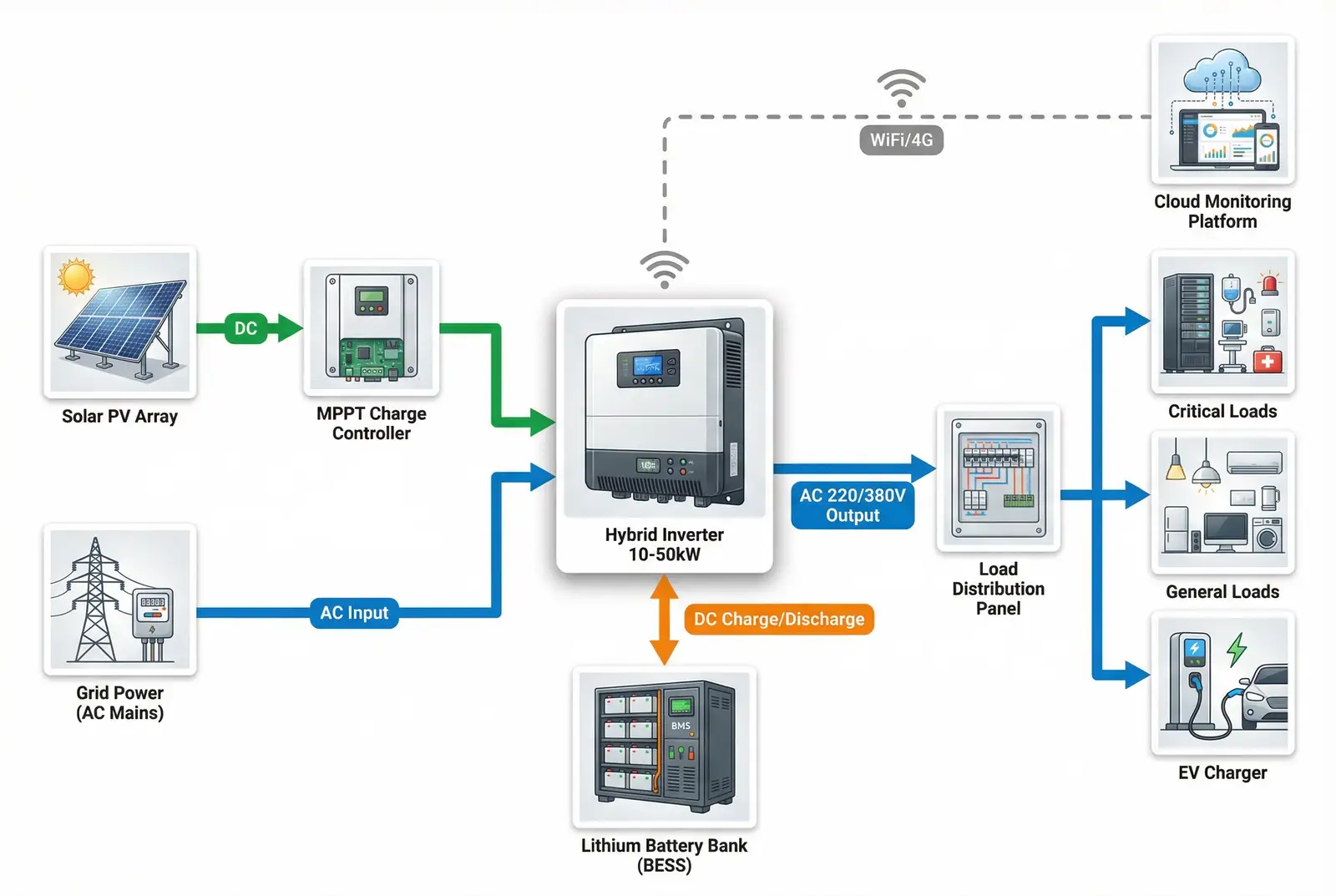
The following products form the core of this solution. Each is selected for optimal performance, reliability, and system compatibility.
High-Efficiency Monocrystalline, 550W+
Primary renewable energy source converting sunlight to DC electricity. High-efficiency cells maximize generation per square meter of available area.
Key Parameters: Power: 550W per panel | Efficiency: >21% | Voltage: 41V Vmp | Warranty: 25-year linear | Degradation: <0.5%/year
Lithium-ion with BMS, 100-500kWh
Stores excess solar energy for use during evening/night or grid outages. Battery Management System ensures safe operation and maximum lifespan.
Key Parameters: Chemistry: LiFePO4 | Capacity: 100-500kWh | Cycles: >6000 at 80% DoD | Efficiency: >95% round-trip | Warranty: 10 years
Grid-Tie + Off-Grid, MPPT
Converts DC from solar/battery to AC for building loads. Manages power flow between solar, battery, grid, and loads. Supports seamless transition to off-grid mode.
Key Parameters: Power: 50-200kW | Efficiency: >98% | MPPT: Multiple trackers | Grid: Bi-directional | Transfer: <20ms
Cloud-Based, AI-Optimized
Intelligent platform that optimizes energy flow based on generation forecasts, load patterns, tariff rates, and battery state of charge.
Key Parameters: Platform: Cloud-based | Analytics: AI/ML optimization | Monitoring: Real-time | Reporting: Automated | API: Open integration
DC Combiner, AC SPD, Breakers
Complete protection for both DC (solar/battery) and AC (grid/load) sides of the system, including surge protection, isolation, and fault detection.
Key Parameters: DC SPD: Type 2 | DC Breakers: per string | AC SPD: Type 1+2 | Monitoring: Arc fault detection | Isolation: DC disconnect
Use the following table to select the appropriate configuration based on your specific requirements:
| System Size | Solar Array | Battery | Inverter | Annual Savings |
|---|---|---|---|---|
| Small Commercial (30kW) | 55 x 550W panels | 50kWh LFP | 30kW Hybrid | ~$8,000-12,000 |
| Medium Commercial (100kW) | 182 x 550W panels | 200kWh LFP | 100kW Hybrid | ~$25,000-40,000 |
| Large Industrial (500kW) | 910 x 550W panels | 500kWh LFP | 500kW Hybrid | ~$100,000-150,000 |
Commercial office buildings, shopping centers, industrial warehouses, agricultural facilities, remote telecom towers, island resorts, and any facility with significant daytime energy consumption and available roof or ground space for solar installation.
Typical payback period of 4-7 years depending on local electricity rates and solar irradiance. Annual energy cost reduction of 30-70%. Grid independence during outages with battery backup. Carbon emission reduction supporting ESG goals. System lifespan: 25+ years for solar, 10-15 years for batteries. Government incentives and tax credits may further reduce payback period.
Design and deploy comprehensive power distribution systems for manufacturing plants with high reliability and scalability requirements.
This solution provides a complete industrial power distribution system from medium-voltage (MV) transformer input to low-voltage (LV) end-use distribution. Designed for manufacturing plants with mixed loads including motors, lighting, HVAC, and process equipment, the system ensures reliable, efficient power delivery with room for future expansion.
The architecture follows a hierarchical distribution model: a step-down transformer converts 10kV to 0.4kV, feeding a Main Distribution Board (MDB) equipped with Air Circuit Breakers (ACB) and Molded Case Circuit Breakers (MCCB). From the MDB, dedicated feeders supply Motor Control Centers (MCC) for production equipment, sub-distribution panels for each production area, and a power factor correction system to optimize energy efficiency and avoid utility penalties.
The solution includes comprehensive protection coordination, ensuring that faults are isolated at the lowest possible level without affecting upstream circuits. All equipment is selected for industrial-grade reliability with consideration for ambient temperature, dust, and vibration.
High Voltage (10kV) Grid Supply connects to a Step-Down Transformer (10/0.4kV), which feeds the Main Distribution Board (MDB) with ACB/MCCB protection. The MDB distributes power to three main branches: Motor Control Center (MCC) for production motors, Sub-Distribution Panels for each production area (Area A, Area B), and a Power Factor Correction Capacitor Bank. Each branch serves its respective end loads.
System Connection Diagram
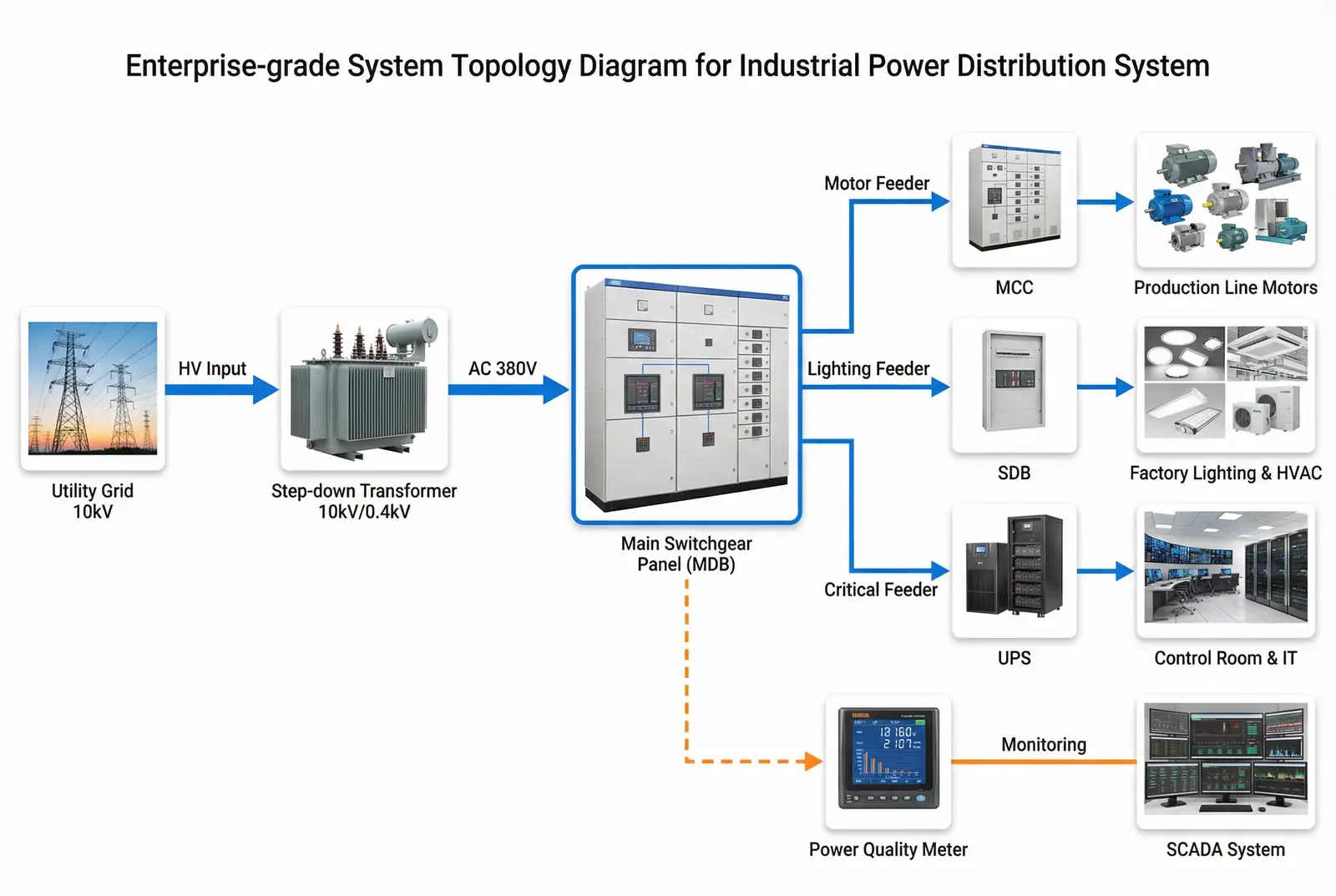
The following products form the core of this solution. Each is selected for optimal performance, reliability, and system compatibility.
10/0.4kV, 500-2000kVA
Converts medium-voltage grid supply to usable low-voltage for factory distribution. Oil-immersed or dry-type depending on installation location and fire safety requirements.
Key Parameters: Ratio: 10/0.4kV | Capacity: 500-2000kVA | Type: Oil-immersed/Dry | Impedance: 4-6% | Cooling: ONAN/AN | Efficiency: >99%
ACB + MCCB, 2000-4000A
Central distribution point for the entire factory. Houses main ACB, feeder MCCBs, metering, and protection relays. Designed for front access maintenance.
Key Parameters: Busbar: 2000-4000A | ACB: Motorized, drawout | MCCBs: Adjustable thermal-magnetic | Metering: Digital multifunction | IP: IP42
Intelligent, Modular Design
Centralized motor starting and protection for all production equipment. Supports DOL, Star-Delta, Soft Start, and VFD starting methods.
Key Parameters: Configuration: Modular drawout | Starters: DOL/SD/SS/VFD | Protection: Overload + Short circuit | Communication: Modbus RTU | IP: IP42
Per-Area, MCCB Protected
Local distribution for each production area, providing circuit-level protection and isolation capability for maintenance.
Key Parameters: Rating: 200-630A | MCCBs: Adjustable | Metering: Per-feeder optional | IP: IP42-IP54 | Material: Powder-coated steel
Automatic, Thyristor-Switched
Maintains power factor above 0.95 to avoid utility penalties and reduce distribution losses. Automatic step control responds to changing load conditions.
Key Parameters: Capacity: 100-500kVAr | Steps: 6-12 automatic | Switching: Thyristor (fast) | Controller: Digital PFC | Detuning: 7% reactor
Use the following table to select the appropriate configuration based on your specific requirements:
| Factory Size | Transformer | MDB | MCC | PFC |
|---|---|---|---|---|
| Small (100-500kW) | 500kVA | 1600A MDB | 4-8 starters | 100kVAr |
| Medium (500-1500kW) | 1000kVA | 2500A MDB | 12-24 starters | 250kVAr |
| Large (1500-3000kW+) | 2000kVA | 4000A MDB | 24-48 starters | 500kVAr |
Manufacturing plants, food processing facilities, automotive assembly lines, textile mills, chemical processing plants, pharmaceutical production, and any industrial facility requiring reliable, scalable power distribution from 500kW to 3000kW+.
Reliable power distribution with 99.9%+ availability. Power factor correction saves 5-15% on electricity bills. Modular design reduces expansion costs by 30-50% compared to full system replacement. Comprehensive metering enables energy optimization. Typical system lifespan: 25-30 years. Estimated investment: $50,000-300,000 depending on capacity.
Implement efficient power distribution for commercial buildings with centralized panel boards, smart metering, and energy management.
Designed for office buildings, shopping malls, hotels, and commercial complexes, this solution provides efficient, manageable power distribution with per-tenant metering and integrated energy management. The system supports multi-floor distribution with centralized monitoring and automated billing capabilities.
The architecture features a main switchboard with bus-coupler for redundancy, floor-level distribution panels, smart meters for each tenant or zone, and integration with emergency systems including fire alarms and emergency lighting. A cloud-based EMS platform aggregates all metering data for automated billing, consumption analytics, and demand management.
This solution is particularly valuable for commercial property managers who need accurate tenant billing, energy cost allocation, and compliance with building energy codes.
Utility Supply feeds the Main Switchboard with Bus-Coupler for redundancy. Main Smart Meter provides overall building metering. Floor Distribution Panels serve each level, with individual Smart Meters per tenant/zone feeding data to a Cloud EMS for billing and analytics. Separate feeds serve Emergency Lighting and Fire Alarm systems.
System Connection Diagram
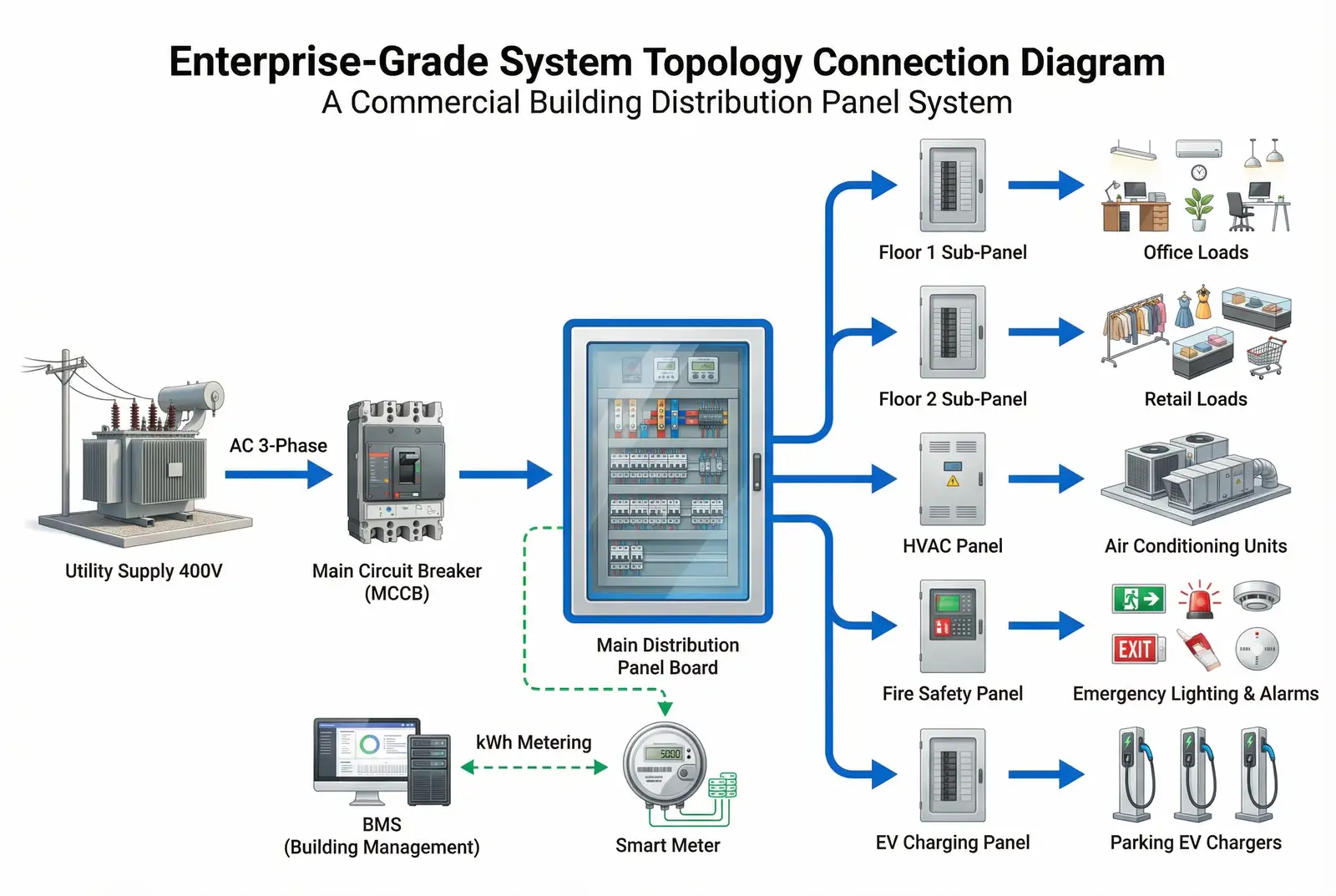
The following products form the core of this solution. Each is selected for optimal performance, reliability, and system compatibility.
Bus-Coupler, 1600-3200A
Central distribution with bus-coupler configuration for enhanced reliability. Supports dual incoming supply for redundancy.
Key Parameters: Busbar: 1600-3200A | ACB: 2x incoming, motorized | Bus-coupler: Interlocked | Metering: Digital | IP: IP42
Per-Floor, MCCB + MCB
Distributes power to individual tenants and common areas on each floor. Includes main isolation switch for floor-level maintenance.
Key Parameters: Rating: 200-400A per floor | MCCBs: Tenant feeders | MCBs: Lighting/socket circuits | IP: IP30 | Mounting: Flush
Multi-Function, RS485/WiFi
Accurate energy measurement for each tenant enabling automated billing. Measures kWh, kVAh, power factor, demand, and harmonics.
Key Parameters: Accuracy: Class 0.5S | Communication: RS485 + WiFi | Parameters: V/I/P/Q/PF/kWh/kVAh | Display: LCD | Certification: MID
Emergency Lighting + Fire Integration
Dedicated emergency lighting distribution with battery backup and fire alarm system integration for automatic load shedding.
Key Parameters: Emergency: Self-contained + central battery | Fire: Alarm integration | Shedding: Automatic non-essential | Backup: 3-hour minimum
Billing, Analytics, Demand Management
Centralized platform for automated tenant billing, energy analytics, demand management, and regulatory compliance reporting.
Key Parameters: Platform: Cloud SaaS | Billing: Automated monthly | Analytics: Real-time + historical | Reports: Customizable | API: REST/MQTT
Use the following table to select the appropriate configuration based on your specific requirements:
| Building Type | Main Switchboard | Floor Panels | Smart Meters | EMS |
|---|---|---|---|---|
| Small Office (5-10 floors) | 1600A Single | 200A per floor | 10-30 meters | Basic Cloud |
| Medium Commercial (10-20 floors) | 2500A Bus-Coupler | 400A per floor | 30-100 meters | Standard Cloud |
| Large Complex (20+ floors) | 3200A Dual Supply | 630A per floor | 100-500 meters | Enterprise Cloud |
Office buildings, shopping malls, hotels, mixed-use developments, co-working spaces, commercial complexes, and any multi-tenant building requiring individual metering and centralized energy management.
Accurate tenant billing eliminates disputes and revenue leakage. Demand management reduces peak charges by 10-20%. Energy analytics identify optimization opportunities saving 5-15% annually. Compliance with building energy codes and green building certifications. Estimated investment: $30,000-200,000 depending on building size.
Deploy compact, factory-assembled substations for rapid power infrastructure deployment in new developments and temporary installations.
Prefabricated substations combine HV switchgear, transformer, and LV distribution in a single weatherproof enclosure, enabling rapid deployment of complete power infrastructure. Factory assembly and testing ensure quality and reduce on-site installation time from weeks to days.
This solution is ideal for new construction projects, temporary power for events or construction, industrial park expansions, and any application requiring fast, reliable power infrastructure deployment. The compact design minimizes land use while maintaining full functionality and safety compliance.
All components are pre-wired, tested, and commissioned at the factory, significantly reducing on-site work and associated risks. The enclosure provides protection against weather, vandalism, and unauthorized access.
HV Cable (10/11kV) enters the weatherproof enclosure connecting to the Ring Main Unit (RMU) for HV switching. The RMU feeds the Transformer (Oil or Dry Type, 10/0.4kV) which steps down to LV. The LV Distribution Panel with MCCB/MCB protection distributes power to external loads. Metering and Protection equipment is integrated within the enclosure.
System Connection Diagram
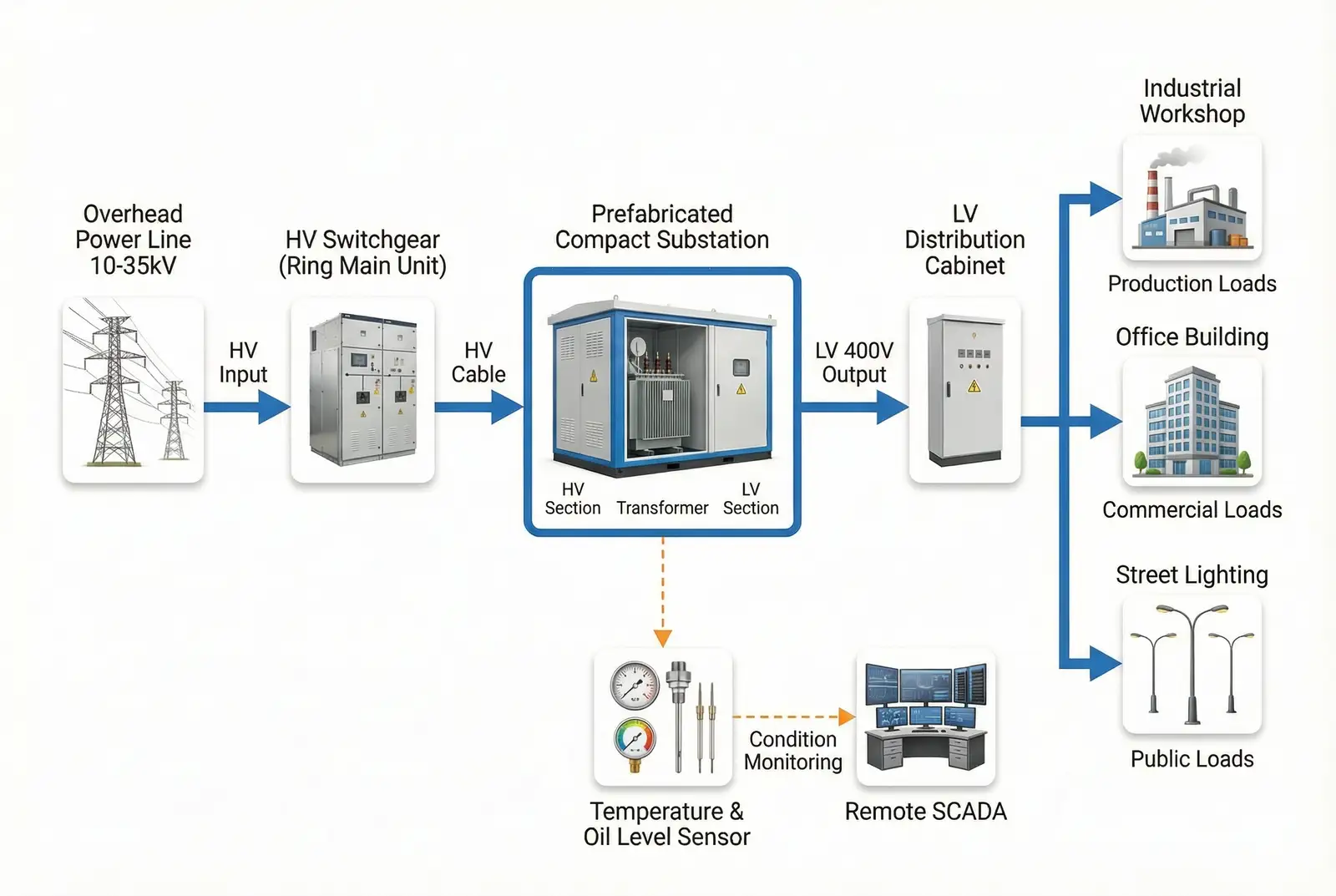
The following products form the core of this solution. Each is selected for optimal performance, reliability, and system compatibility.
SF6/Vacuum, 12-24kV
Compact HV switchgear for incoming/outgoing cable connections and transformer protection. Enables loop feed configuration for enhanced reliability.
Key Parameters: Voltage: 12-24kV | Configuration: 2-way or 3-way | Insulation: SF6 or Solid | Breaking: Vacuum | IP: IP67
Oil/Dry Type, 315-2000kVA
Steps down medium voltage to low voltage for distribution. Choice of oil-immersed (higher efficiency) or dry-type (fire-safe for indoor/enclosed use).
Key Parameters: Ratio: 10/0.4kV | Capacity: 315-2000kVA | Type: ONAN or AN | Losses: Low-loss design | Efficiency: >99%
MCCB Protected, 1000-2500A
Low-voltage distribution with multiple outgoing feeders for external loads. Includes metering, protection, and capacitor bank connection.
Key Parameters: Busbar: 1000-2500A | MCCBs: Adjustable | Metering: Digital multifunction | Outgoing: 6-12 feeders | IP: IP42
Steel/Concrete, IP43+
Factory-built enclosure housing all equipment with proper ventilation, lighting, safety signage, and access control.
Key Parameters: Material: Galvanized steel or concrete | IP: IP43+ | Ventilation: Natural + forced | Access: Lockable doors | Fire: 2-hour rated walls
Revenue Metering + Relay Protection
Revenue-grade metering for utility billing and comprehensive relay protection for transformer and feeder circuits.
Key Parameters: Metering: Class 0.2S CT + 0.2 VT | Relay: Overcurrent + Earth fault | Communication: RS485/Ethernet | Display: Local + Remote
Use the following table to select the appropriate configuration based on your specific requirements:
| Application | Transformer | RMU | LV Panel | Enclosure |
|---|---|---|---|---|
| Residential Development | 315-630kVA | 2-way RMU | 1000A Panel | Compact Steel |
| Commercial Complex | 630-1000kVA | 3-way RMU | 1600A Panel | Standard Steel |
| Industrial Park | 1000-2000kVA | 3-way RMU | 2500A Panel | Heavy-duty Concrete |
New residential developments, commercial building projects, industrial park expansions, temporary event power, construction site main supply, mining operations, and any application requiring rapid deployment of 315kVA to 2000kVA transformer capacity.
70% faster deployment compared to conventional substations. 40-60% smaller footprint. Factory quality assurance with full type testing. Relocatable for temporary applications. Estimated investment: $20,000-100,000 depending on capacity and configuration.
Protect precision machinery, medical equipment, and IT infrastructure from voltage fluctuations with professional voltage regulation solutions.
Voltage fluctuations are one of the most common and damaging power quality issues, causing equipment malfunction, reduced lifespan, and production losses. This solution provides multi-level voltage stabilization from utility input to point-of-use, ensuring clean, stable power for all critical loads.
The system employs a layered approach: a main voltage stabilizer at the building entry handles bulk voltage correction, precision voltage regulators protect individual critical equipment, and UPS systems provide both voltage regulation and battery backup for IT and sensitive electronics. A power quality monitor continuously tracks voltage, frequency, harmonics, and other parameters.
This solution is essential for facilities with unstable grid supply (voltage range 180-260V), sensitive manufacturing equipment (CNC machines, medical devices), or IT infrastructure requiring clean power.
Unstable Grid Power (180-260V fluctuation) enters the Main 3-Phase Voltage Stabilizer at the building entry point. Stabilized output feeds the Distribution Panel, which branches to three specialized paths: Precision Voltage Regulators for CNC/precision machinery, UPS Systems for IT equipment (servers and network), and Medical-Grade Isolation Transformers for medical equipment. A Power Quality Monitor tracks all parameters.
System Connection Diagram
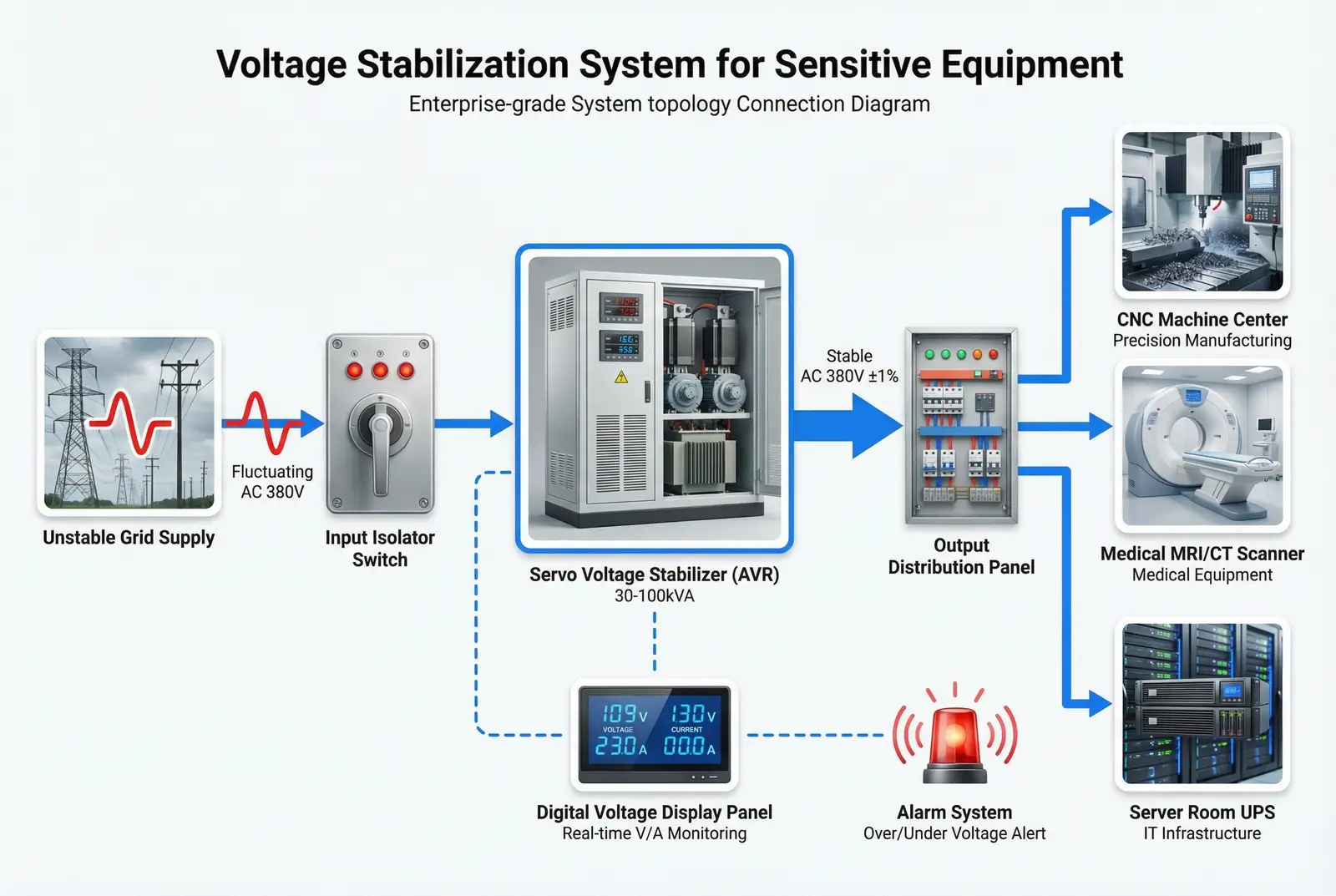
The following products form the core of this solution. Each is selected for optimal performance, reliability, and system compatibility.
3-Phase, 50-500kVA, Servo Motor
Primary voltage correction at building entry. Handles wide input range (160-260V) and delivers stable output (380V±2%) for all downstream loads.
Key Parameters: Capacity: 50-500kVA | Input: 304-456V (3P) | Output: 380V±2% | Response: <0.5s | Type: Servo Motor | Efficiency: >98%
Single/3-Phase, 1-30kVA
Ultra-precise voltage regulation (±1%) for individual CNC machines, measurement equipment, and other precision loads.
Key Parameters: Capacity: 1-30kVA | Output: 220V±1% or 380V±1% | Response: <20ms | Waveform: Pure sine | Regulation: Electronic
Online Double-Conversion, 3-40kVA
Provides both voltage regulation and battery backup for IT equipment. Online topology ensures zero transfer time and complete isolation from grid disturbances.
Key Parameters: Capacity: 3-40kVA | Topology: Online double-conversion | Transfer: 0ms | Battery: 15-60 min | Efficiency: >95% | Output: Pure sine
Hospital Grade, 3-15kVA
Provides galvanic isolation and clean power for medical equipment in operating rooms and diagnostic areas.
Key Parameters: Capacity: 3-15kVA | Isolation: >4kV | Leakage: <100µA | Regulation: ±2% | Standard: IEC 61558 | Monitoring: Insulation monitor
Class A, Multi-Parameter
Continuously monitors voltage, current, frequency, harmonics, flicker, and transients. Logs data for analysis and triggers alarms for out-of-range conditions.
Key Parameters: Class: IEC 61000-4-30 Class A | Parameters: V/I/P/Q/THD/Flicker | Logging: Continuous | Communication: Ethernet/RS485 | Display: Color LCD
Use the following table to select the appropriate configuration based on your specific requirements:
| Application | Main Stabilizer | Precision Regulator | UPS | Monitor |
|---|---|---|---|---|
| Small Office/Clinic | 30kVA Servo | 5kVA Electronic | 3kVA Online | Basic PQ Meter |
| Factory/Workshop | 100-200kVA Servo | 10-30kVA per CNC | 10kVA for IT | Class A Monitor |
| Hospital/Data Center | 300-500kVA Servo | 15kVA per OR | 40kVA+ Modular | Class A + Logger |
Hospitals and medical facilities, CNC machining workshops, semiconductor manufacturing, data centers, research laboratories, broadcasting studios, and any facility with sensitive equipment requiring voltage stability better than ±5%.
Eliminates voltage-related equipment failures and production losses. Extends equipment lifespan by 20-40%. Reduces maintenance costs for sensitive machinery. Ensures compliance with medical equipment power standards. Typical ROI: 6-18 months based on prevented downtime. Estimated investment: $5,000-100,000 depending on capacity and application.
Optimize motor-driven processes with variable frequency drives for significant energy savings and precise speed control.
Variable Frequency Drives (VFDs) enable precise motor speed control, reducing energy consumption by 20-50% for variable-torque applications like pumps, fans, and compressors. This solution covers the complete VFD system from selection and sizing to installation, filtering, and integration with building or process automation systems.
The solution addresses the full signal chain: input filtering for EMC compliance, the VFD unit itself for motor control, output filtering to protect motor insulation from high dV/dt, and bypass switching for critical applications that cannot tolerate VFD failure. Integration with BMS/SCADA systems enables centralized monitoring and control.
Energy savings from VFD applications follow the affinity laws: reducing motor speed by 20% reduces energy consumption by approximately 50%, making VFDs one of the highest-ROI energy efficiency investments available.
AC Power (380V 3-Phase) passes through an Input Filter (EMC Line Reactor) to the VFD Unit, which controls motor speed via variable frequency output. An Output Filter (dV/dt Reactor) protects the motor insulation. The motor drives mechanical loads (pumps, fans, compressors). A Bypass Switch provides DOL backup for critical applications. The VFD communicates with BMS/SCADA via Modbus/Profibus for centralized control.
System Connection Diagram
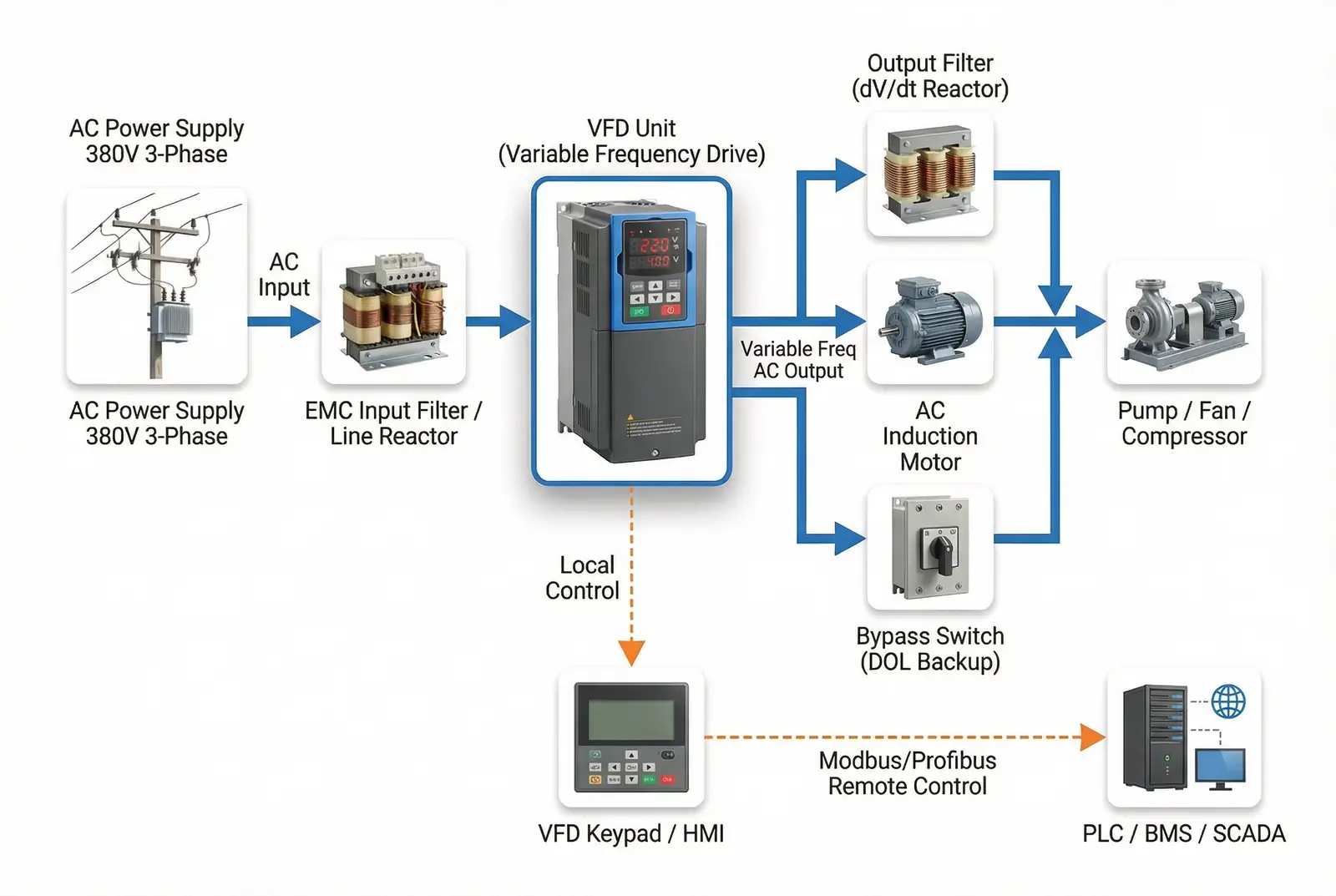
The following products form the core of this solution. Each is selected for optimal performance, reliability, and system compatibility.
0.75-500kW, Vector Control
Core speed control unit converting fixed-frequency AC to variable-frequency AC for precise motor speed regulation.
Key Parameters: Power: 0.75-500kW | Control: Sensorless Vector | Input: 380V 3P | Output: 0-380V 0-400Hz | Overload: 150% for 60s | Communication: Modbus/Profibus/Ethernet
3-5% Impedance
Reduces harmonic distortion on the supply side and protects VFD from voltage spikes. Essential for installations with multiple VFDs.
Key Parameters: Impedance: 3-5% | Harmonic reduction: THDi from 80% to 35% | Voltage drop: <3% | Cooling: Natural air | IP: IP00
Motor Protection
Reduces voltage rise rate (dV/dt) at motor terminals, protecting motor insulation from premature failure, especially for long cable runs.
Key Parameters: dV/dt reduction: >90% | Cable length: up to 300m | Frequency: up to 400Hz | Cooling: Natural air | Voltage drop: <2%
Manual/Auto, DOL Backup
Provides direct-on-line (DOL) backup path for critical applications. Allows motor operation at fixed speed if VFD fails.
Key Parameters: Type: Manual or Automatic | Rating: Matched to motor | Interlocking: Mechanical + electrical | Indication: LED status | Transition: Bumpless (auto)
Multi-Protocol Gateway
Enables centralized monitoring and control of all VFDs from building management or SCADA systems.
Key Parameters: Protocols: Modbus RTU/TCP, BACnet, Profibus, Ethernet/IP | Data: Speed, current, power, faults | Control: Start/stop, speed setpoint | Logging: Historical trends
Use the following table to select the appropriate configuration based on your specific requirements:
| Application | VFD Size | Input Filter | Output Filter | Bypass |
|---|---|---|---|---|
| HVAC Fan/Pump (5-30kW) | 7.5-37kW VFD | 3% Line Reactor | Optional | Manual |
| Process Pump (30-100kW) | 37-132kW VFD | 5% Line Reactor | Recommended | Automatic |
| Large Compressor (100-500kW) | 132-560kW VFD | Active Front End | Required | Automatic |
HVAC systems (AHU fans, chilled water pumps, cooling tower fans), water/wastewater treatment (pumping stations, blowers), manufacturing (conveyors, mixers, extruders), mining (crushers, mills, conveyors), and any application with variable-speed motor requirements.
Energy savings of 20-50% with typical payback of 1-3 years. Reduced mechanical wear extends motor and driven equipment lifespan by 30-50%. Lower starting current reduces demand charges. Improved process control and product quality. Estimated investment: $500-50,000 per VFD depending on motor size.
Implement multi-level surge protection to safeguard electrical systems from lightning strikes and transient overvoltages.
This solution implements a comprehensive, coordinated surge protection strategy using Type 1, Type 2, and Type 3 SPDs in a cascaded configuration. The system protects electrical infrastructure from direct lightning strikes, indirect lightning effects, and switching transients that can damage or destroy sensitive equipment.
The protection philosophy follows the zone concept defined in IEC 62305: external lightning protection (lightning rods and down conductors) diverts direct strikes, while internal protection (SPDs at multiple levels) progressively reduces residual surge energy to safe levels for connected equipment. A properly designed grounding system ties all protection elements together.
Signal and data line protection is equally important — surge energy can enter through communication cables, antenna feeds, and sensor wiring. This solution addresses both power and signal line protection for complete facility protection.
Lightning Strike or Grid Surge energy is first handled by Type 1 SPD (Lightning Arrestor) at the Main Distribution, reducing surge to <4kV. Type 2 SPD at Sub-Distribution panels further reduces to <1.5kV. Type 3 SPD at Point-of-Use provides fine protection to <0.8kV for sensitive equipment. Signal Line SPDs protect data and communication cables. All SPDs are bonded to a comprehensive Grounding System (earth electrode and bonding network).
System Connection Diagram
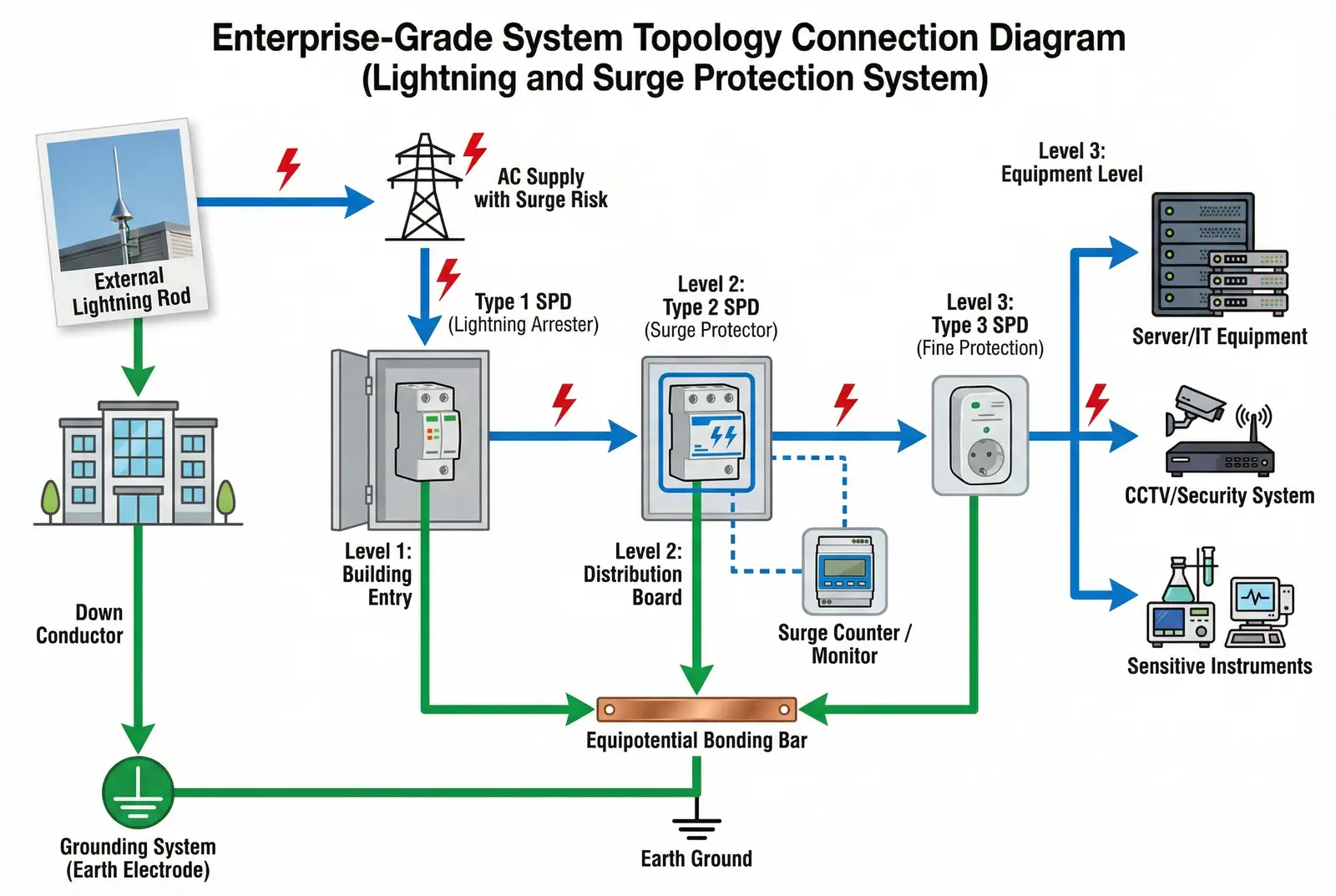
The following products form the core of this solution. Each is selected for optimal performance, reliability, and system compatibility.
Class I, 50-100kA
First line of defense at main distribution. Handles direct lightning current (10/350µs waveform) and diverts massive surge energy to ground.
Key Parameters: Class: Type 1 (Class I) | Iimp: 50-100kA (10/350µs) | Up: <4kV | Uc: 350V | Backup: External fuse | Indication: Visual + remote
Class II, 40-80kA
Second level protection at sub-distribution panels. Handles indirect lightning and switching surges (8/20µs waveform).
Key Parameters: Class: Type 2 (Class II) | Imax: 40-80kA (8/20µs) | Up: <1.5kV | Uc: 275V | Technology: MOV | Indication: Visual + remote
Class III, 5-10kA
Point-of-use protection installed directly at or near sensitive equipment. Provides final voltage clamping to safe levels.
Key Parameters: Class: Type 3 (Class III) | Imax: 5-10kA | Up: <0.8kV | Form: Socket/DIN rail | Technology: MOV + GDT | Response: <1ns
Data/Telecom/Antenna
Protects data lines (Ethernet, RS485), telephone lines, antenna feeds, and sensor wiring from surge damage.
Key Parameters: Types: Ethernet (PoE compatible), RS485, Coax, 4-20mA | Bandwidth: Up to 10Gbps | Insertion loss: <0.5dB | Response: <1ns
Earth Electrode + Bonding Network
Foundation of all surge protection. Low-impedance path to earth for surge energy dissipation. Equipotential bonding prevents dangerous voltage differences.
Key Parameters: Earth resistance: <10Ω (general), <1Ω (sensitive) | Electrodes: Copper-clad steel rods | Bonding: Copper tape/cable | Testing: Annual measurement
Use the following table to select the appropriate configuration based on your specific requirements:
| Protection Level | Type 1 SPD | Type 2 SPD | Type 3 SPD | Signal SPD |
|---|---|---|---|---|
| Basic (Low risk) | 25kA per pole | 40kA per pole | At sensitive equipment | Ethernet only |
| Standard (Medium risk) | 50kA per pole | 40kA per pole | All IT + medical | Ethernet + Telecom |
| Enhanced (High risk) | 100kA per pole | 80kA per pole | All equipment | All signal lines |
Commercial buildings, industrial facilities, data centers, telecommunications towers, hospitals, schools, government buildings, and any facility in lightning-prone areas or with sensitive electronic equipment requiring surge protection.
Prevents equipment damage from lightning and surge events — a single direct lightning strike can cause $50,000-500,000 in equipment damage. Insurance compliance for lightning-prone areas. Reduced downtime from surge-related failures. System lifespan: 10-20 years with periodic SPD replacement. Estimated investment: $2,000-50,000 depending on facility size and protection level.
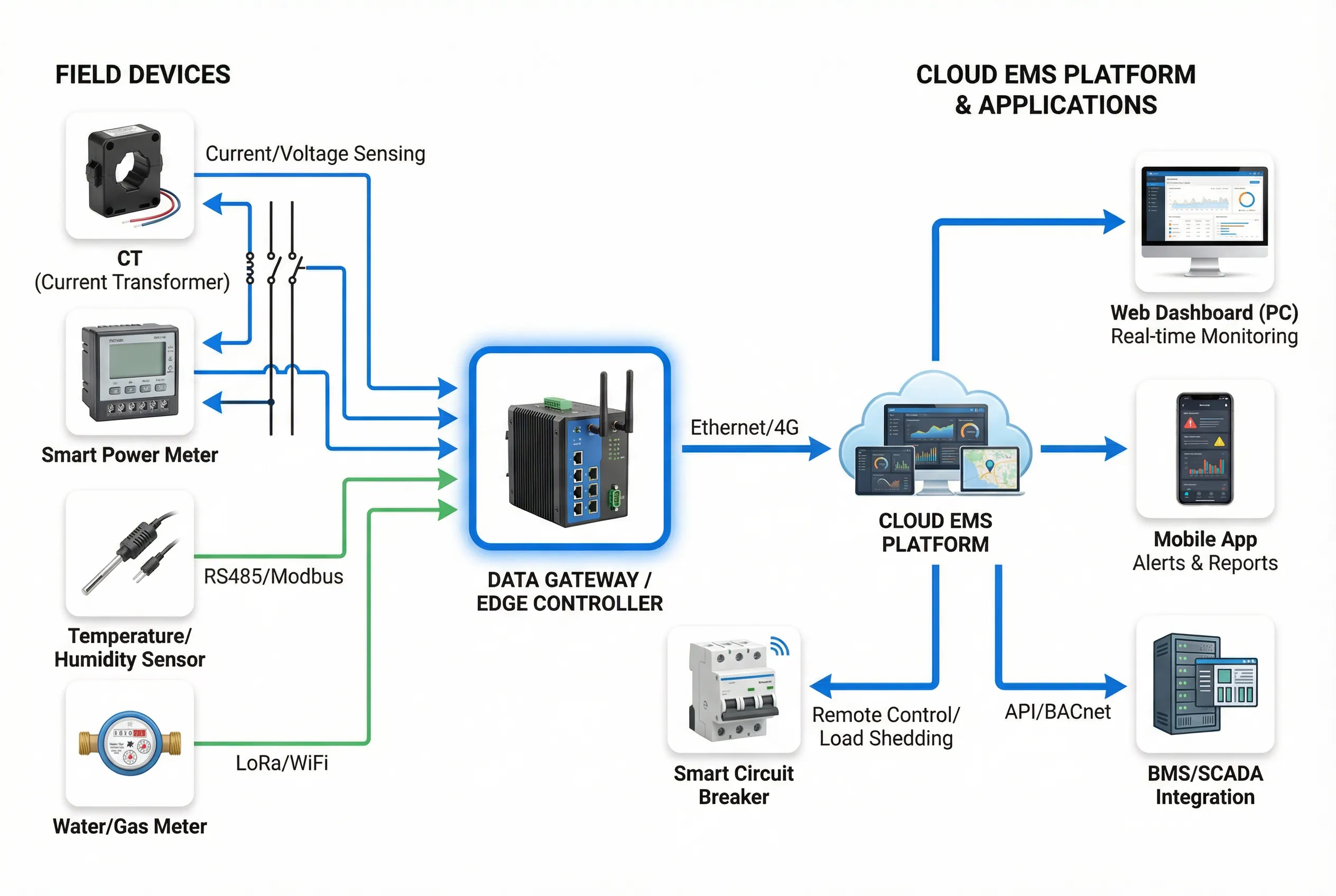
Deploy comprehensive energy management systems for real-time monitoring, analysis, and optimization of power consumption.
This solution provides end-to-end energy visibility through a network of smart meters, sensors, and analyzers connected to a cloud-based Energy Management System (EMS) platform. The system enables data-driven decisions for energy optimization, demand management, cost reduction, and sustainability reporting.
The monitoring architecture covers all levels of the distribution system: main incoming supply, sub-distribution panels, individual equipment or zones, and renewable energy sources. Data is collected via a protocol gateway that supports multiple communication standards (Modbus, BACnet, MQTT) and transmitted to the cloud platform for processing and visualization.
Advanced analytics including AI/ML algorithms identify consumption patterns, detect anomalies, predict demand, and recommend optimization actions. Automated reporting supports compliance with energy regulations and green building certifications.
Three data sources feed the system: Smart Meters at main and sub-distribution points, CT/VT Sensors for current and voltage measurement, and Power Quality Analyzers for detailed power analysis. All connect to a Data Gateway (Protocol Converter supporting Modbus/BACnet) which transmits to the Cloud EMS Platform. The platform provides four outputs: Real-time Dashboard, Automated Reports & Alerts, Energy Optimization Recommendations, and BMS/SCADA Integration.
System Connection Diagram
The following products form the core of this solution. Each is selected for optimal performance, reliability, and system compatibility.
Multi-Function, Class 0.5S
High-accuracy energy measurement at distribution points. Measures all electrical parameters including energy, demand, power factor, and harmonics.
Key Parameters: Accuracy: Class 0.5S | Parameters: V/I/P/Q/PF/kWh/kVAh/THD | Communication: RS485 + Ethernet | Display: LCD | Certification: MID/IEC
Split-Core CT, 50-5000A
Non-invasive current measurement using split-core design for easy retrofit installation without circuit interruption.
Key Parameters: Range: 50-5000A | Accuracy: Class 0.5 | Type: Split-core (retrofit) | Output: 5A or 1A secondary | Burden: <5VA
Class A, IEC 61000-4-30
Detailed power quality analysis including harmonics up to 50th order, flicker, voltage dips/swells, and transients.
Key Parameters: Class: IEC 61000-4-30 Class A | Harmonics: Up to 50th | Transients: 10MHz sampling | Logging: 1GB+ internal | Communication: Ethernet/WiFi
Multi-Protocol, Edge Computing
Collects data from all meters and sensors, performs edge processing, and transmits to cloud platform. Supports multiple protocols simultaneously.
Key Parameters: Protocols: Modbus RTU/TCP, BACnet, MQTT, OPC-UA | Capacity: 200+ devices | Edge: Local processing + buffering | Communication: 4G/Ethernet/WiFi
SaaS, AI-Powered Analytics
Central platform for visualization, analytics, reporting, and optimization. AI algorithms identify savings opportunities and predict consumption.
Key Parameters: Deployment: Cloud SaaS | Analytics: AI/ML powered | Dashboard: Customizable | Reports: Automated scheduling | API: REST/MQTT | Mobile: iOS/Android app
Use the following table to select the appropriate configuration based on your specific requirements:
| Facility Type | Meters | Sensors | Gateway | Platform |
|---|---|---|---|---|
| Small Commercial (10 points) | 10 smart meters | 20 CTs | 1 gateway | Basic Cloud |
| Medium Industrial (50 points) | 50 smart meters | 100 CTs + PQ analyzer | 2 gateways | Standard Cloud |
| Large Campus (200+ points) | 200+ smart meters | 500+ CTs + PQ analyzers | 5+ gateways | Enterprise Cloud |
Commercial office buildings, shopping malls, industrial plants, university campuses, hospital complexes, hotel chains, and any facility seeking to optimize energy consumption, reduce costs, and meet sustainability targets.
Typical energy savings of 10-25% through optimization and demand management. Peak demand reduction of 10-25% through load shifting. Automated reporting saves 20+ hours per month. Anomaly detection prevents equipment failures. Supports green building certifications (LEED, BREEAM). Estimated investment: $10,000-100,000 depending on monitoring scope.
Implement smart metering infrastructure for accurate energy billing, demand management, and consumption analytics.
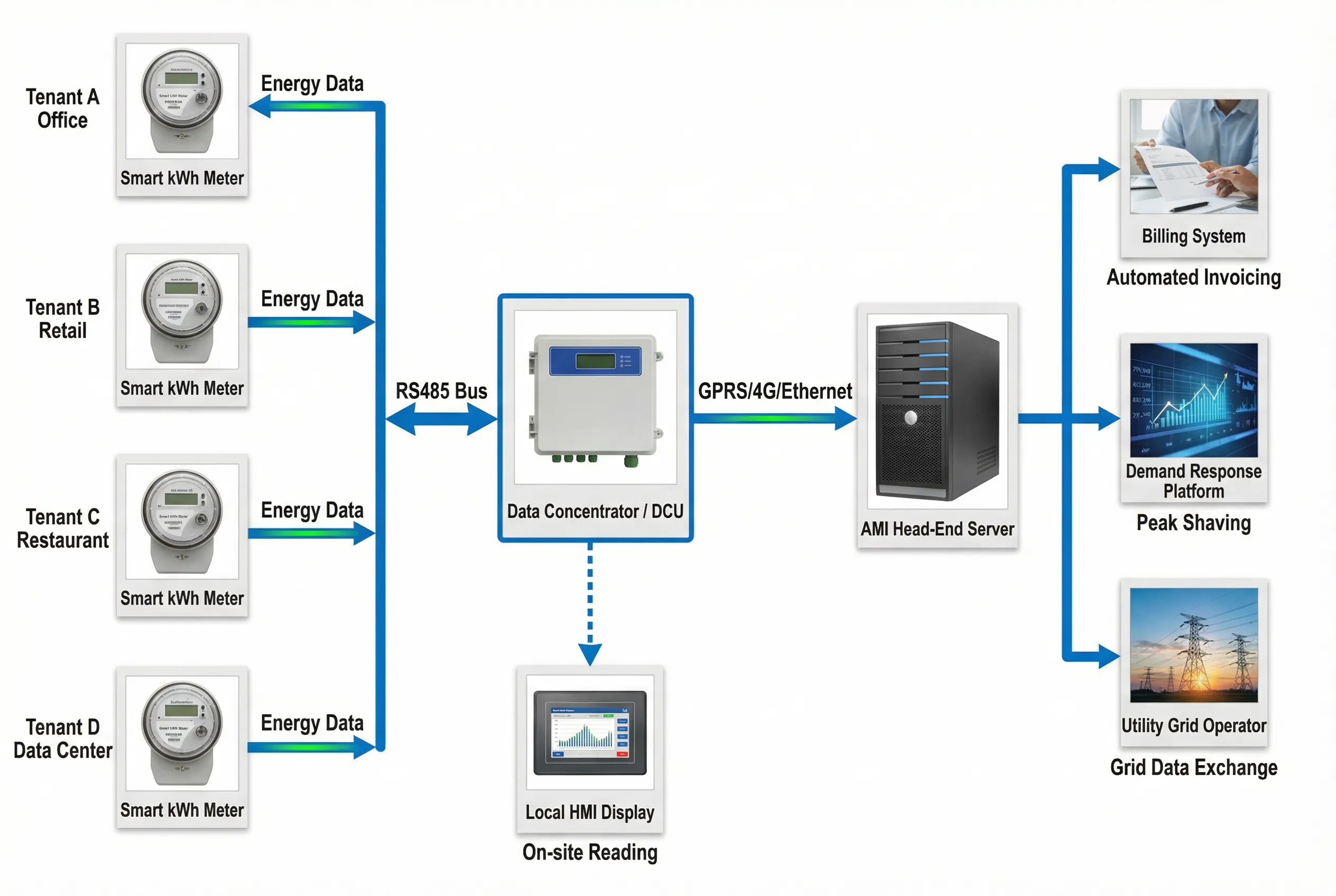
Smart metering enables accurate, real-time energy measurement for tenant billing, cost allocation, and consumption optimization in commercial facilities. This solution covers the complete metering infrastructure from individual smart meters to centralized data collection and cloud-based billing and analytics platform.
The system replaces traditional manual meter reading with automated data collection, eliminating reading errors and enabling real-time consumption visibility. Multi-function meters measure not just energy (kWh) but also demand (kW), power factor, harmonics, and other parameters that provide deeper insight into consumption patterns.
For multi-tenant buildings, the solution enables fair, accurate cost allocation based on actual consumption rather than estimates. Demand response capabilities allow participation in utility demand response programs for additional revenue.
Utility Supply feeds through a Main Smart Meter (bi-directional for net metering) to the Distribution Panel. Individual Tenant Smart Meters (with RS485/WiFi communication) measure each tenant's consumption. All meters connect to a Data Collector/Concentrator which aggregates data and transmits to the Cloud Platform for billing, analytics, and tenant portal access. Integration with Utility AMI systems enables demand response participation.
System Connection Diagram
The following products form the core of this solution. Each is selected for optimal performance, reliability, and system compatibility.
Bi-Directional, Class 0.2S
High-accuracy main meter for utility billing. Bi-directional capability supports net metering for buildings with solar generation.
Key Parameters: Accuracy: Class 0.2S | Direction: Bi-directional | Communication: RS485 + 4G | Parameters: Full electrical | Certification: Utility-approved
Multi-Function, RS485/WiFi
Individual meters for each tenant or zone. Compact DIN-rail design for easy installation in existing distribution panels.
Key Parameters: Accuracy: Class 1.0 | Size: 2-4 DIN modules | Communication: RS485 + WiFi optional | Display: LCD | Tamper: Detection + logging
Multi-Channel, Edge Processing
Collects data from all meters via RS485 bus, performs local processing and storage, and transmits aggregated data to cloud platform.
Key Parameters: Channels: Up to 128 meters | Storage: 30-day local buffer | Communication: 4G/Ethernet | Processing: Edge analytics | Power: 24VDC or PoE
Automated Billing & Analytics
Generates automated monthly bills for each tenant, provides consumption analytics, and manages tariff structures.
Key Parameters: Billing: Automated monthly | Tariffs: Multi-rate, TOU, demand | Reports: PDF/Email | Portal: Tenant self-service | Payment: Integration ready
Utility Integration
Enables participation in utility demand response programs by automatically shedding non-critical loads during peak events.
Key Parameters: Protocol: OpenADR 2.0 | Response: Automatic load shedding | Loads: Configurable priority | Notification: Advance warning | Revenue: Demand response credits
Use the following table to select the appropriate configuration based on your specific requirements:
| Building Type | Main Meter | Tenant Meters | Concentrator | Platform |
|---|---|---|---|---|
| Small Office (10 tenants) | 1x Class 0.5S | 10 DIN-rail meters | 1 concentrator | Basic Billing |
| Medium Commercial (50 tenants) | 1x Class 0.2S | 50 DIN-rail meters | 2 concentrators | Standard Billing + Analytics |
| Large Complex (200+ tenants) | 2x Class 0.2S | 200+ meters | 4+ concentrators | Enterprise + Demand Response |
Multi-tenant office buildings, shopping centers, industrial parks, co-working spaces, residential complexes, university dormitories, and any facility requiring individual energy metering and automated billing.
Eliminates billing disputes through accurate, transparent metering. Reduces meter reading labor costs by 90%. Tenant portal reduces billing inquiries by 70%. Demand response participation can generate $5-20/kW/year in credits. Consumption visibility typically motivates 5-10% voluntary energy reduction by tenants. Estimated investment: $200-500 per metering point.
Design and install high-capacity busbar systems for efficient, reliable power distribution in industrial and commercial applications.
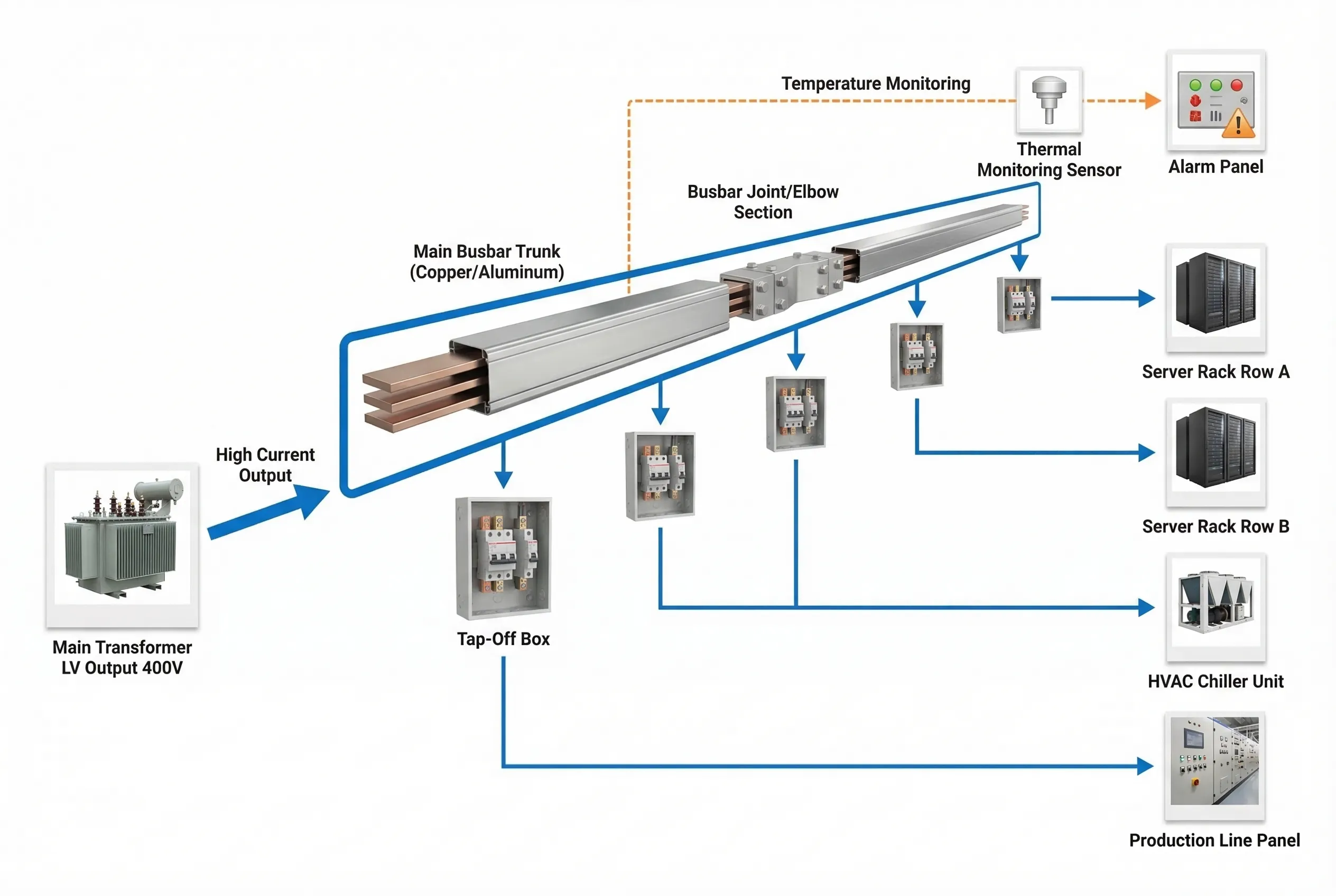
Busbar trunking systems provide a compact, efficient, and flexible alternative to traditional cable-based power distribution for high-current applications. This solution covers the complete busbar system from design and sizing to installation, testing, and commissioning.
Busbar systems offer significant advantages over cables: higher current-carrying capacity per unit cross-section, lower voltage drop, easier installation, flexible tap-off points for load connections, and better thermal management. They are particularly suited for vertical risers in high-rise buildings, horizontal distribution in factories and data centers, and any application requiring frequent load connection changes.
The solution includes proper fire barrier and expansion joint design to maintain building fire compartmentation and accommodate thermal expansion, ensuring both safety and long-term reliability.
Transformer LV Output (0.4kV) connects to the Main Switchboard with ACB protection. The Busbar Trunking System (copper busbar main run) extends through the facility with Tap-Off Units at each floor or zone (Floor/Zone A, B, C). Each tap-off feeds a Local Distribution Panel. Fire Barriers and Expansion Joints are installed at building compartment boundaries.
System Connection Diagram
The following products form the core of this solution. Each is selected for optimal performance, reliability, and system compatibility.
Copper, 800-5000A
Main power distribution backbone carrying high current from switchboard to load centers. Sandwich construction with copper conductors in aluminum housing.
Key Parameters: Rating: 800-5000A | Conductor: Copper (>99.9%) | Housing: Aluminum | IP: IP54 | Voltage drop: <1V/100m | Temperature rise: <55K
Plug-In, 63-630A
Plug-in connection points along the busbar for load connections. Hot-swappable design allows adding or relocating connections without system shutdown.
Key Parameters: Rating: 63-630A | Type: Plug-in (hot-swap) | Protection: MCCB/Fuse | Phases: 3P+N+PE | Mounting: Left/Right/Bottom
Flexible Joints, Fire Barriers
Flexible joints accommodate thermal expansion and building movement. Fire barriers maintain fire compartmentation at floor/wall penetrations.
Key Parameters: Expansion: ±15mm per joint | Fire rating: 2-hour (EI120) | Sealing: Intumescent | Testing: EN 1366-3
Cable Box, Flexible Connection
Connects busbar system to transformer or switchboard output. Flexible connection absorbs vibration and misalignment.
Key Parameters: Type: Cable box or flexible bar | Rating: Matched to busbar | Connection: Bolted | Insulation: Shrink-fit
Thermal Imaging, Resistance Testing
Commissioning and ongoing monitoring tools to verify joint integrity and detect hotspots before they cause failures.
Key Parameters: Thermal: IR camera survey | Resistance: Micro-ohm meter | Insulation: 1000V megger | Frequency: Annual survey recommended
Use the following table to select the appropriate configuration based on your specific requirements:
| Application | Busbar Rating | Tap-Off Units | Fire Barriers | Length |
|---|---|---|---|---|
| High-Rise Riser (10-20 floors) | 1600-2500A | 1-2 per floor | Every floor | 30-60m vertical |
| Factory Horizontal | 2500-4000A | Every 3-6m | At fire walls | 50-200m horizontal |
| Data Center | 3200-5000A | Per rack row | Per fire zone | 20-100m horizontal |
High-rise commercial buildings (vertical risers), industrial factories (horizontal distribution), data centers (power to rack rows), shopping malls, hospitals, and any application requiring high-current distribution with flexibility for future load changes.
30-40% space savings compared to cable installations. 50% faster installation time. Lower voltage drop improves energy efficiency. Hot-swappable tap-offs provide unmatched flexibility. 25+ year lifespan with minimal maintenance. Estimated investment: $100-300 per meter of busbar run, depending on current rating.
Before selecting any product, clearly define what you need the power system to achieve. This foundational step prevents costly mismatches.
Different scenarios have vastly different requirements. Identifying your specific scenario narrows product selection significantly.
Review all technical limitations and regulatory requirements that may affect product selection and system design.
Select the right quality and performance tier based on your application criticality and budget considerations.
No power product works in isolation. Identify all supporting products needed for a complete, functional system.
The core value of power equipment lies in reliable, continuous operation — not in its purchase price.
When evaluating power equipment, the purchase price typically represents only 20-40% of the total cost of ownership. The remaining 60-80% comes from energy consumption, maintenance, downtime costs, and eventual replacement. A generator that costs 15% more but delivers 25% better fuel efficiency will save significantly more over its 15-20 year lifespan.
Enterprise buyers should evaluate products based on: reliability metrics (MTBF/MTTR), energy efficiency ratings, maintenance requirements and costs, manufacturer support and warranty, and total lifecycle cost.
Buyers often overlook installation complexity, environmental requirements, and maintenance schedules.
Many procurement decisions focus solely on product specifications and price, missing critical factors that determine real-world performance. Common oversights include: installation requirements (foundation, ventilation, access), environmental suitability (temperature, humidity, altitude derating), maintenance accessibility, spare parts availability, and integration with existing systems.
A thorough site assessment and system-level evaluation before purchase can prevent 80% of post-installation issues and significantly reduce total project cost.
A product with 10% higher purchase price but 30% better fuel efficiency saves significantly more over its lifetime.
Total Cost of Ownership (TCO) includes: initial purchase price, installation and commissioning costs, energy/fuel consumption over the lifespan, scheduled maintenance costs, unscheduled repair costs, downtime costs, and decommissioning/disposal costs. For power generation equipment, energy costs alone can exceed the purchase price within 2-3 years of operation.
Use our Lifecycle Cost Calculator to compare different product options.
Non-compliant products may create legal liability, insurance issues, and safety hazards.
Electrical products must comply with local and international standards (IEC, UL, CE, CCC) to ensure safety and legal operation. Non-compliant products can void insurance coverage, create legal liability in case of incidents, fail safety inspections, and result in project delays or shutdowns. Always verify that products carry appropriate certifications for your target market and application.
Electrical equipment failures can cause fires, electrocution, and facility damage.
Selecting inappropriate or low-quality electrical equipment creates serious safety risks. Undersized cables can overheat and cause fires. Inadequate protection devices fail to isolate faults. Poor-quality connections create arc flash hazards. Always prioritize safety ratings, proper sizing, and quality certifications when selecting power equipment.
The best product is the one that best matches your specific scenario and requirements.
A 500kW generator is not "better" than a 50kW generator — it's simply designed for a different application. The best product is the one that precisely matches your load profile, environmental conditions, operational requirements, and budget constraints. Over-specification wastes capital and reduces efficiency, while under-specification creates reliability risks.
Reputable manufacturers maintain consistent quality across production batches.
Consistent quality means every unit performs to specification, not just the sample tested during evaluation. Reputable manufacturers implement ISO 9001 quality management, conduct 100% testing of critical parameters, maintain traceability of components, and provide consistent documentation. This consistency is especially important for large-scale deployments where equipment interchangeability is essential.
Energy efficiency, maintenance frequency, and expected lifespan all contribute to total cost of ownership.
Long-term operating costs are driven by three main factors: energy consumption (fuel or electricity), maintenance requirements (frequency, complexity, parts cost), and expected lifespan before replacement. A product with 5% better energy efficiency operating 8,000 hours per year can save tens of thousands of dollars over its lifetime. Similarly, products designed for easy maintenance reduce labor costs and downtime.
A structured, professional framework for enterprise buyers to evaluate, compare, and confidently select the right power equipment — from generators to monitoring systems.

Before you can select the right power equipment, you must first articulate precisely what your power system needs to accomplish. This is not simply a matter of listing the devices you want to power — it requires a systematic analysis of your operational requirements, reliability expectations, and long-term business continuity goals.
Power systems serve fundamentally different purposes depending on the context. A backup generator for a small office has entirely different requirements from a primary power source for a remote mining operation. Begin by categorizing your need into one of these primary functions:
Once you understand the purpose, calculate your actual power needs with engineering precision. Avoid the common mistake of simply adding up nameplate ratings — actual operating loads are typically 60–80% of nameplate values, but starting loads (especially for motors) can be 3–7 times the running load.
Different operations have vastly different tolerance for power interruptions. A data center may require 99.999% uptime (less than 5 minutes of downtime per year), while a warehouse may tolerate several hours of downtime without significant business impact. Define your uptime requirements explicitly, as they directly determine the level of redundancy, the quality tier of equipment, and the total system cost.
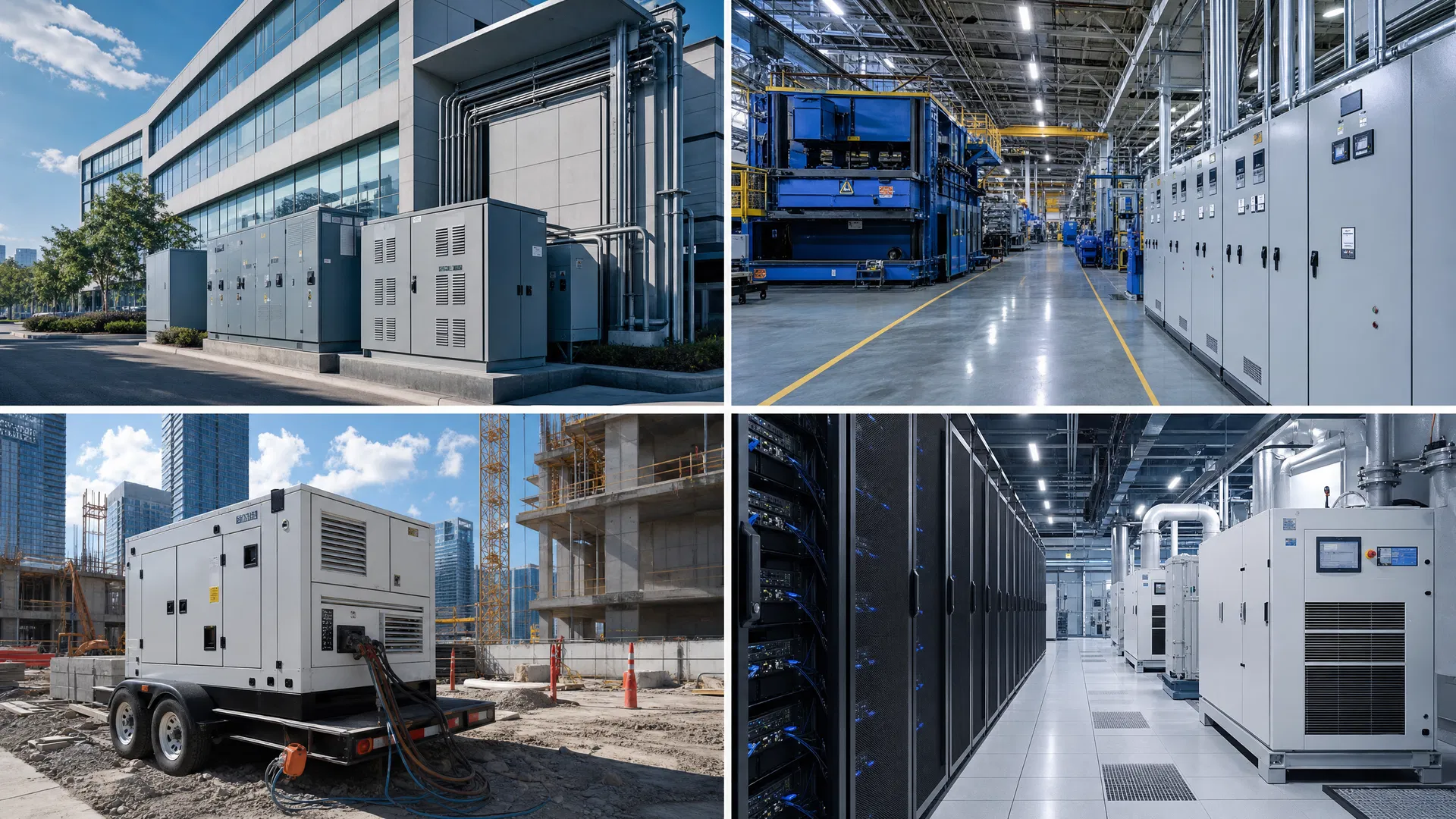
The physical and operational environment where your power system will be deployed has a profound impact on product selection. Equipment that performs flawlessly in a climate-controlled office building may fail within months in a tropical industrial facility. This chapter guides you through a systematic environmental and operational scenario analysis.
Conduct a thorough assessment of the installation site before specifying any equipment:
Match your application to the appropriate scenario category to identify the right product class:
Understanding how your load varies over time is essential for optimal equipment sizing. A facility with a flat, predictable load profile can be sized more tightly than one with highly variable loads. Use power quality analyzers to record actual load data over at least one full operational cycle (typically one week) before finalizing equipment specifications.
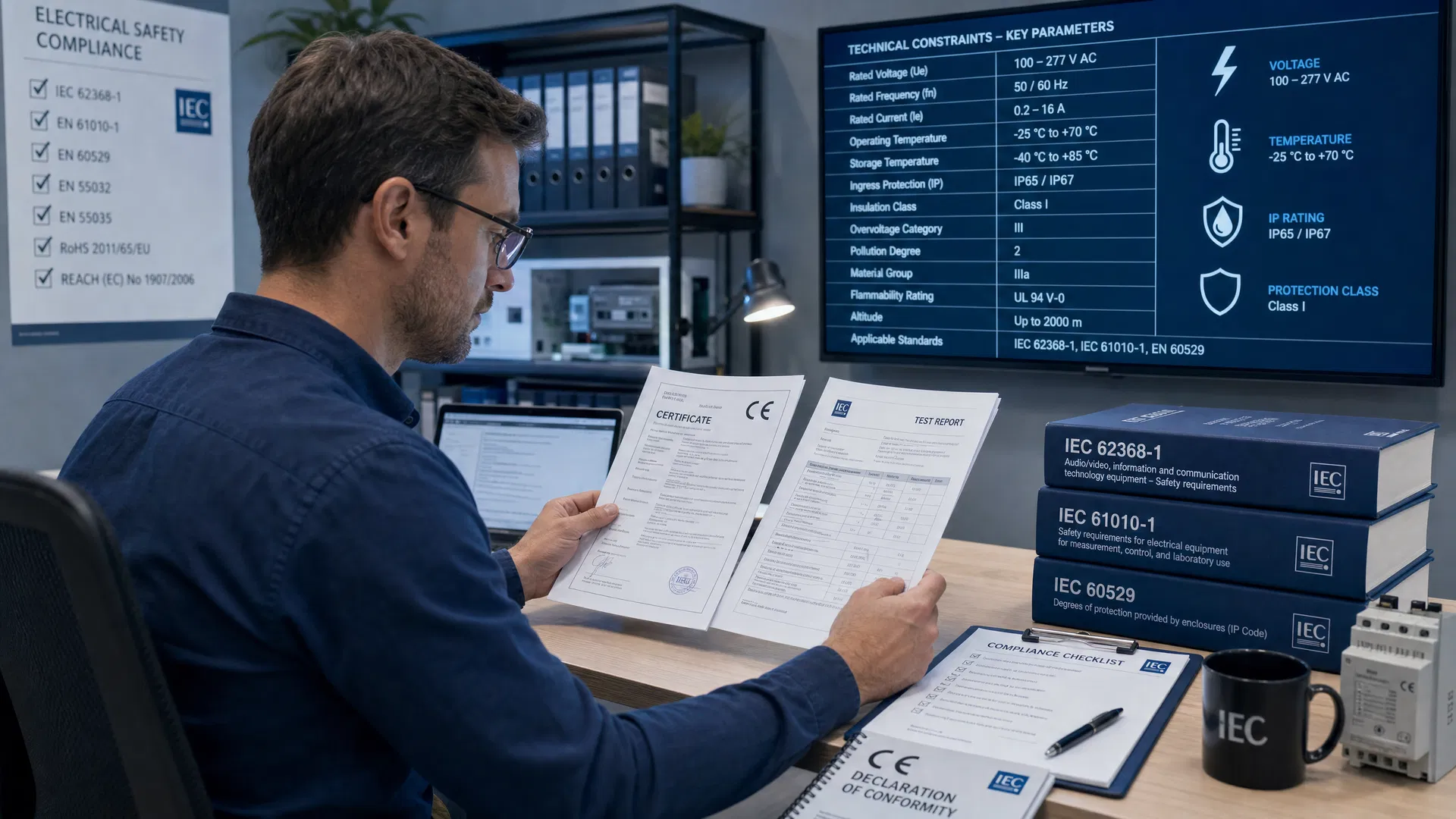
Every power system installation operates within a framework of technical standards, regulatory requirements, and practical constraints. Ignoring these constraints is one of the most common and costly mistakes in power equipment procurement. This chapter provides a comprehensive framework for constraint identification and management.
Power equipment must comply with applicable standards in your jurisdiction. Non-compliant equipment can result in permit rejections, insurance voidance, and significant legal liability:
Beyond regulatory requirements, your installation will face technical constraints that must be addressed in equipment specifications:
Establish a realistic total cost of ownership (TCO) budget that includes not just the equipment purchase price, but also installation, commissioning, annual maintenance, fuel costs (for generators), and eventual replacement. A 10% higher upfront investment in premium equipment often yields 30–50% lower TCO over a 15-year lifecycle.
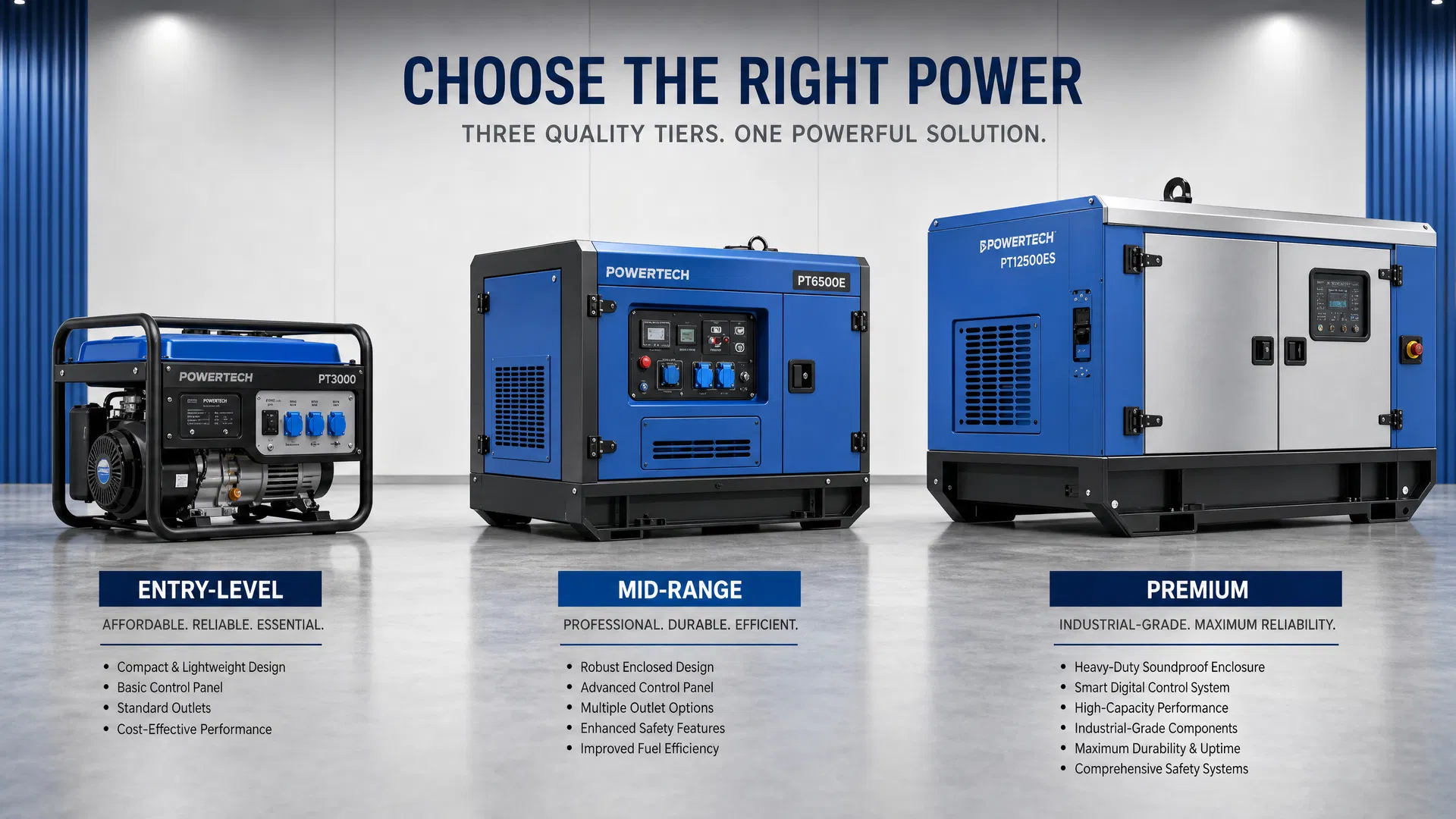
Power equipment is available across a wide spectrum of quality tiers, from budget-oriented commercial products to mission-critical industrial-grade systems. Selecting the appropriate grade requires balancing reliability requirements, operational environment, budget constraints, and lifecycle cost objectives. This chapter provides a structured framework for grade selection.
Quality differences between tiers are not merely cosmetic — they reflect fundamental differences in component selection, manufacturing processes, quality control, and design margins:
Use this decision framework to identify the appropriate grade for your application:
The manufacturer's reputation, financial stability, and local service network are as important as the product specifications. A technically superior product from a manufacturer with poor local support can result in extended downtime during failures. Evaluate manufacturers on: years in business, installed base size, local service network coverage, spare parts availability, and warranty terms.
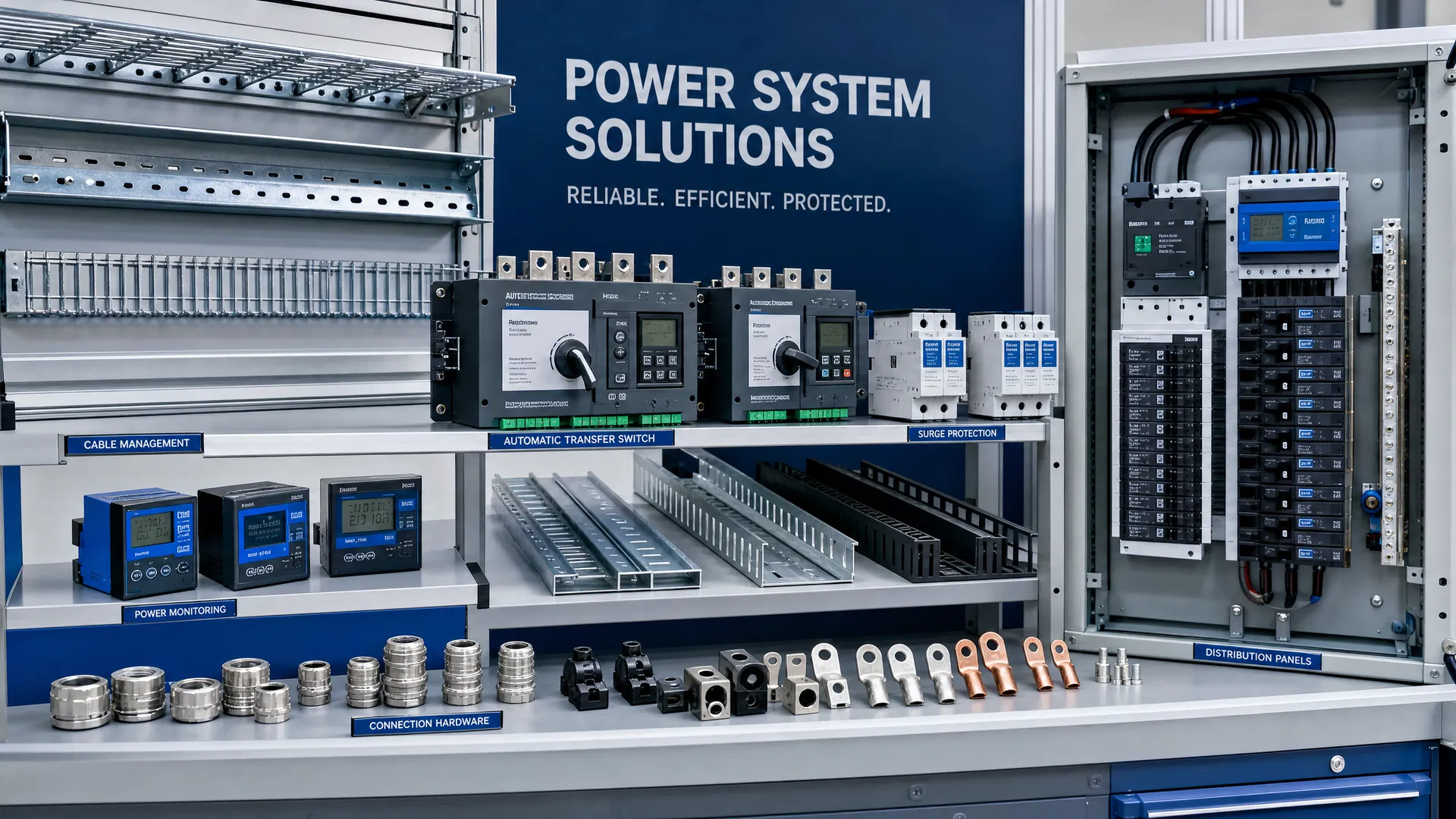
No power system component operates in isolation. Every generator, transformer, UPS, or switchgear panel requires a carefully selected ecosystem of supporting components to function safely, efficiently, and reliably. This final step ensures that your procurement scope is complete and that all necessary accessories are specified, sourced, and budgeted.
Every power system requires appropriate protection and switching equipment to safely manage power flow and protect against faults:
Modern power systems require comprehensive monitoring and power quality management to optimize performance and detect problems before they cause failures:
The physical infrastructure supporting your power equipment is often overlooked but is critical to system reliability and safety:
Before issuing a purchase order, create a comprehensive bill of materials (BOM) that includes every component, accessory, spare part, and consumable required for installation, commissioning, and the first year of operation. A complete BOM prevents costly delays caused by missing components and ensures that all items are budgeted and procured from compatible sources.